
Refrigerated Air Dryer vs Desiccant Air Dryer: Key Differences Explained
the industrial compressed air systems, moisture is one of the biggest challenges affecting performance, efficiency, and equipment life. To solve this problem, air dryers are essential. However, when it comes to choosing the right solution, many industries get confused between two major options: refrigerated air dryers and desiccant air dryers.
Both serve the same purpose—removing moisture from compressed air—but they work in completely different ways and are suited for different applications.
In this guide, we will break down the key differences between refrigerated air dryers and desiccant air dryers, helping you choose the best option for your industrial needs.
What is a refrigerated air dryer?
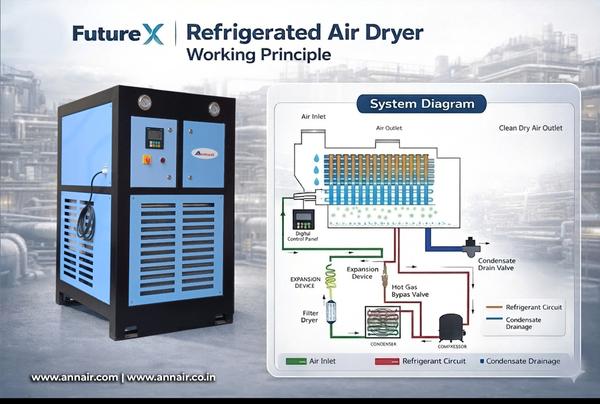
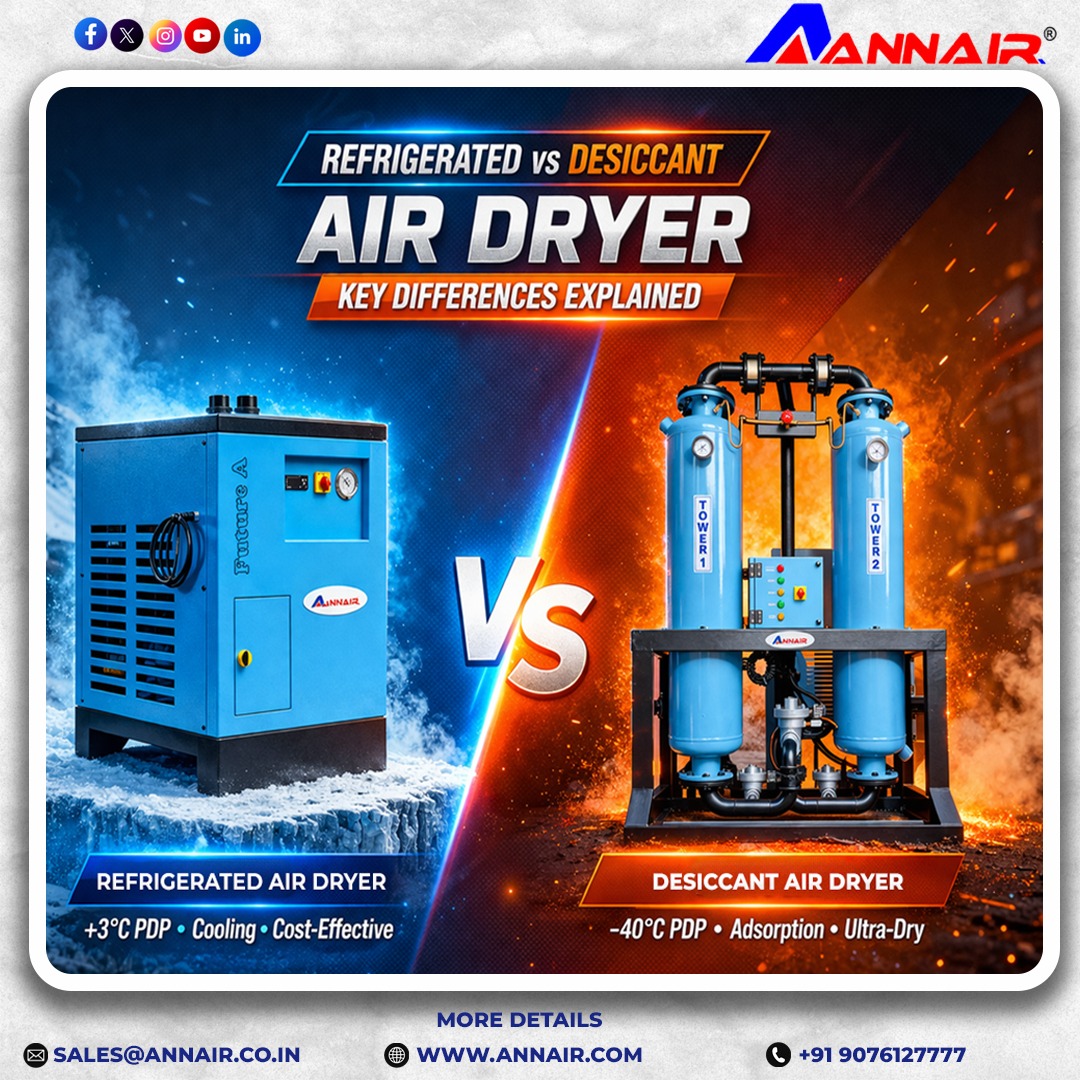
A refrigerated air dryer works by cooling compressed air to a low temperature (typically around 3°C to 5°C). This cooling process condenses moisture into water, which is then removed from the system.
Key Features:
Uses refrigeration technology (similar to an AC system)
Maintains a consistent dew point (~3°C)
Ideal for general industrial applications
Low operating cost
Best For:
Manufacturing plants
Automotive industries
Workshops
General compressed air systems
What is a desiccant air dryer?
A desiccant air dryer uses special drying materials (like activated alumina or silica gel) to absorb moisture from compressed air. Instead of cooling, it chemically removes water vapor.
Key Features:
Uses adsorption process
Achieves ultra-low dew points (-40°C to -70°C)
Suitable for critical applications
Requires regular maintenance
Best For:
Pharmaceutical industries
Food processing
Electronics manufacturing
Chemical industries
Refrigerated Air Dryer vs Desiccant Air Dryer: Key Differences
1. Working Principle
Refrigerated Air Dryer: Cools air to remove moisture through condensation.
Desiccant Air Dryer: Uses adsorbent materials to absorb moisture from air.
👉 Simple Understanding:
Refrigerated = Cooling method
Desiccant = Chemical absorption method
2. Dew Point Performance
Refrigerated Air Dryer: +3°C to +5°C
Desiccant Air Dryer: -40°C to -70°C
👉 If your application requires extremely dry air, desiccant dryers are the better choice.
3. Application Suitability
Refrigerated Dryer: Suitable for standard industrial use where moderate dryness is enough.
Desiccant Dryer: Required in industries where even tiny amounts of moisture can cause damage.
👉 Example:
Normal factory → Refrigerated
Pharma/food → Desiccant
4. Energy Consumption
Refrigerated Air Dryer: Low energy consumption
Desiccant Air Dryer: High energy usage (especially heatless type)
👉 Refrigerated dryers are more cost-efficient for long-term use.
5. Maintenance Requirements
Refrigerated Dryer: Minimal maintenance
Desiccant Dryer: Requires regular replacement of desiccant material
👉 Maintenance cost is higher in desiccant dryers.
6. Initial Cost
Refrigerated Dryer: Lower upfront cost
Desiccant Dryer: Higher investment
👉 For budget-conscious industries, refrigerated dryers are more suitable.
7. Operating Environment
Refrigerated Dryer: Performs best in normal ambient conditions
Desiccant Dryer: Works well even in extreme cold environments
Advantages of Refrigerated Air Dryer
Cost-effective solution
Energy-efficient operation
Easy installation
Low maintenance
Reliable for general use
Advantages of Desiccant Air Dryer
Provides ultra-dry air
Ideal for sensitive applications
Works in extreme conditions
Prevents corrosion and contamination
Disadvantages of Refrigerated Air Dryer
Cannot achieve very low dew points
Not suitable for critical applications
Performance may drop in extreme conditions
Disadvantages of Desiccant Air Dryer
High energy consumption
Expensive maintenance
Higher initial investment
Which Air Dryer Should You Choose?
Choosing between a refrigerated air dryer and a desiccant air dryer depends entirely on your application requirements.
Choose a Refrigerated Air Dryer if:
You need a cost-effective solution
Your application does not require ultra-dry air
You want low maintenance and energy savings
Choose a desiccant air dryer if:
You need extremely dry air (-40°C or below)
Your industry demands high purity (pharma, food, electronics)
Moisture can cause serious damage
Industry Use Comparison Table
Feature | Refrigerated Air Dryer | Desiccant Air Dryer |
|---|---|---|
Dew Point | +3°C to +5°C | -40°C to -70°C |
Cost | Low | High |
Maintenance | Low | High |
Energy Use | Low | High |
Application | General Industry | Critical Industry |
Conclusion
Both refrigerated air dryers and desiccant air dryers play a crucial role in maintaining the efficiency of compressed air systems. The right choice depends on your industry requirements, budget, and desired air quality.
For most industrial applications, a refrigerated air dryer offers a perfect balance of cost and performance. However, if your operations demand ultra-dry air, investing in a desiccant air dryer is the better decision.
Understanding these key differences will help you make an informed choice and improve the overall performance and lifespan of your equipment.
Contact us for more details
📞 Phone: +91 9076127777
📧 Email: sales@annair.co.in
🌐 Website: www.annair.com