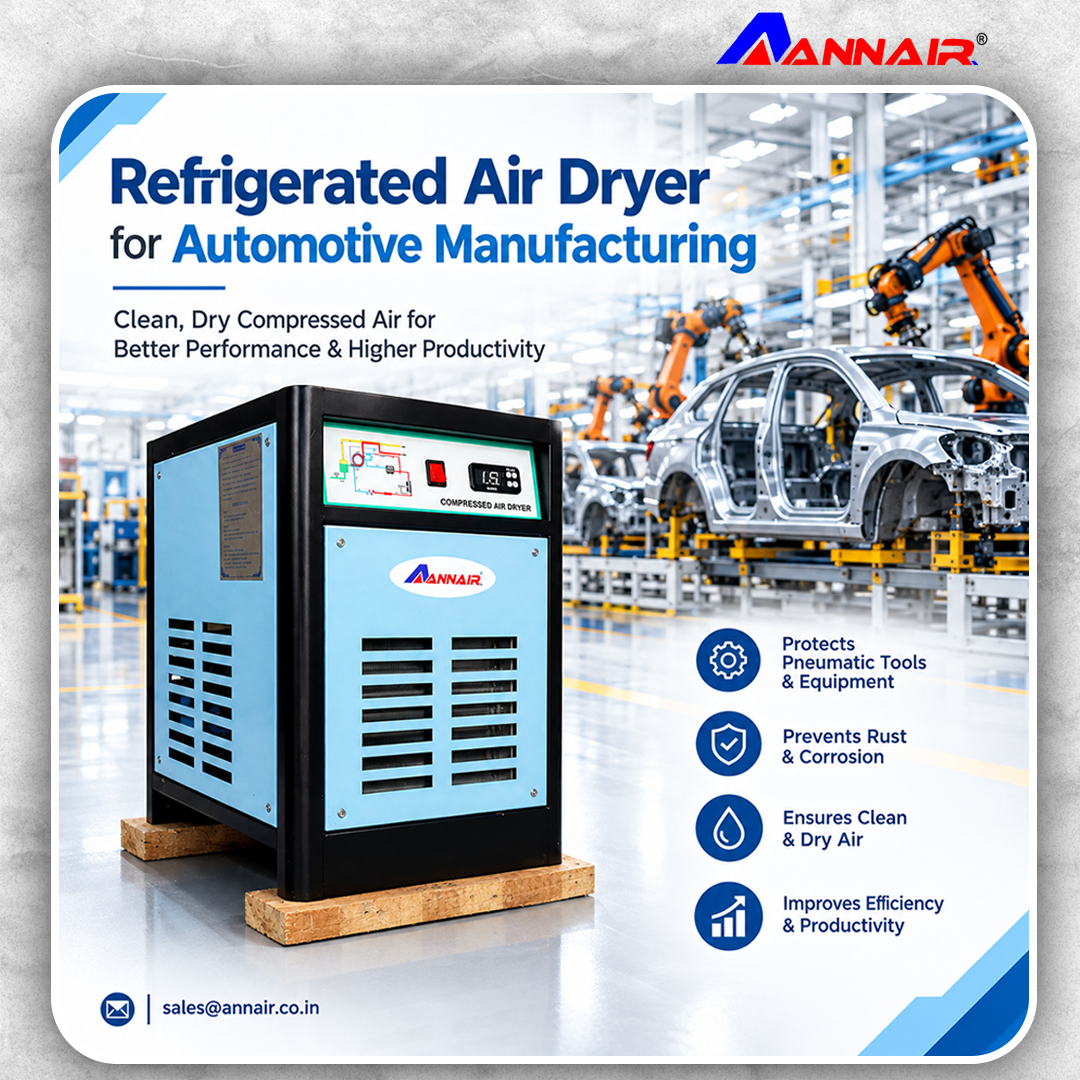
Refrigerated Air Dryer for Automotive Manufacturing: Why It's Non-Negotiable on Your Shop Floor
By Annair Drychill Tech India Pvt. Ltd. | Industrial Air Treatment Solutions
Walk through any automotive manufacturing plant and you'll find compressed air running almost everywhere—pneumatic torque tools, robotic welding cells, paint booths, assembly line actuators, and body-in-white operations. What most plants don't see, until it costs them, is the moisture riding along inside that compressed air.
A single humid air line can corrode a torque wrench overnight, ruin a paint job with fisheyes, or seize a pneumatic cylinder mid-shift. For an industry where tolerances are measured in microns and downtime is measured in lakhs per hour, a refrigerated air dryer for automotive manufacturing isn't an add-on. It's part of the production line itself.
Why Automotive Plants Can't Run on Wet Compressed Air
Compressed air picks up atmospheric moisture the moment it's drawn into the compressor. As that air cools down the pipeline, the moisture condenses—and in an automotive plant, that condensate ends up exactly where you don't want it.
In paint shops, moisture in the air line shows up as fisheyes, blistering, and adhesion failure on the finish coat—defects that mean rework or a scrapped panel. In pneumatic tooling, water washes out lubrication, leading to premature wear in torque guns and impact wrenches used on the assembly line. In robotic weld cells, moisture in the pneumatic actuation lines causes erratic cylinder response, which shows up as inconsistent weld positioning.
None of this is theoretical. It's the reason so many OEM plants and Tier-1 suppliers specify a refrigerated dryer as a mandatory part of their compressed air system design, not an optional upgrade.
How a Refrigerated Air Dryer Actually Solves This
A refrigerated air dryer works on a simple principle: cool the compressed air down to a controlled low temperature (typically around 3°C), force the moisture to condense out as liquid, drain it away, and then reheat the air slightly before it goes back into your distribution line. What comes out the other side is air with a stable, low dew point—meaning it stays dry even as it moves through your plant's pipework.
For automotive manufacturing specifically, this matters because the applications are so varied within one facility. The same compressed air header might be feeding a paint booth, a CNC machining cell, and a pneumatic conveyor—each with different sensitivity to moisture, but all of them better off with dry air.
Uses of Refrigerated Air Dryers Across an Automotive Plant
Paint shops and coating lines: Dry air prevents moisture-related paint defects and keeps spray guns and atomizers running without water contamination in the nozzle.
Pneumatic assembly tools: Torque wrenches, nut runners, and impact tools depend on clean, dry air to maintain accurate torque output—critical for fastener tightening specs on chassis and engine assembly.
Robotic welding and actuation systems: Pneumatic cylinders in weld fixtures need consistent air quality to maintain positioning accuracy across thousands of weld cycles a day.
CNC and machining centers: Air-operated clamping and tool-change systems run more reliably when moisture isn't corroding valve seats and solenoids.
Pneumatic conveying and material handling: Dry air reduces buildup and blockages in conveying lines used for components and small parts.
Benefits That Show Up on the Balance Sheet
The case for a refrigerated air dryer in automotive manufacturing isn't just about avoiding problems—it shows up directly in plant economics.
Fewer unplanned stoppages: Moisture-related failures in pneumatic tools and valves are one of the more common causes of micro-stops on an assembly line. Removing the moisture removes a chunk of that downtime.
Lower maintenance spend: Dry air means less corrosion inside pipework, fewer stuck solenoid valves, and longer service life for pneumatic cylinders and tooling.
Better first-pass yield in paint operations: Fewer moisture-related coating defects means less rework and fewer scrapped panels.
Protection for capital equipment: Robotic arms, CNC machines, and automated conveyors represent serious capital investment—dry air protects the pneumatic components inside them.
Consistent output across seasons: Ambient humidity swings between monsoon and winter months in India change how much moisture your compressor pulls in. A refrigerated dryer keeps your air quality consistent regardless of the season.
Need the right refrigerated air dryer sized for your plant's compressed air load?
Annair Drychill Tech's engineering team can help you match dryer capacity to your automotive production line's actual demand.
Talk to Our Team on WhatsAppChoosing the Right Refrigerated Air Dryer for an Automotive Plant
Not every refrigerated dryer is sized or built the same way, and automotive plants have a few requirements worth checking before you buy.
Match capacity to actual air demand, not compressor nameplate rating. Sizing a dryer off your compressor's rated output rather than your plant's real, measured air consumption is one of the more common mistakes we see—it usually leads to oversizing and wasted energy cost.
Check the pressure dew point rating. For most automotive applications, a dew point of 3°C to 5°C is adequate. Paint booths and precision pneumatic tooling may call for tighter control.
Factor in ambient plant temperature. Shop floors running hot, especially near paint curing ovens or welding bays, need a dryer rated for higher inlet air temperatures.
Look at energy consumption per cfm. Since these dryers run continuously, the difference between an efficient unit and an inefficient one adds up fast on your electricity bill over a year.
Confirm after-sales support and spares availability. A plant running three shifts can't afford a dryer sitting idle waiting for a part. Local service support in your region matters as much as the machine specs.
Frequently Asked Questions
1. What dew point does an automotive manufacturing plant actually need?
Most general assembly and machining operations run comfortably at a 3°C to 5°C pressure dew point, which is standard output for a refrigerated air dryer. Paint booths and certain precision pneumatic applications sometimes call for tighter control, in which case a combination of refrigerated and supplementary drying may be recommended.
2. Can one refrigerated air dryer serve an entire automotive plant, or do we need multiple units?
It depends on your plant layout and total compressed air demand. Centralized systems with a single large dryer work well for plants with a unified air header, while plants with separate zones (like a standalone paint shop) sometimes benefit from a dedicated smaller unit for that zone, so a paint line shutdown doesn't take down the whole plant's air supply.
3. How is a refrigerated air dryer different from a heatless desiccant dryer, and which one do we need?
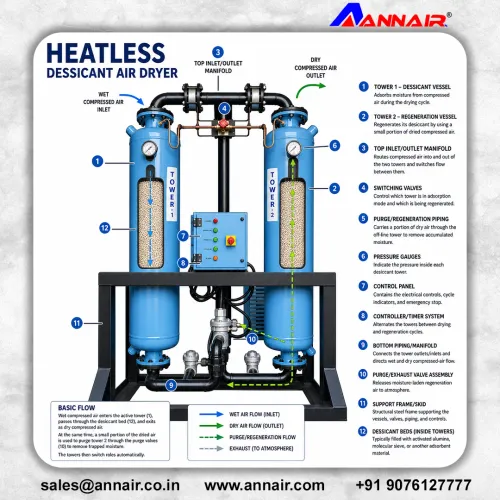
A refrigerated dryer cools air to condense out moisture and is well suited to general plant air needs at a lower operating cost. A heatless desiccant dryer achieves a much lower dew point (often -40°C) using adsorbent material and is typically reserved for applications with extreme moisture sensitivity. Most automotive assembly and machining operations run well on refrigerated drying alone; desiccant systems are usually added only where a specific process demands it.
4. What's the typical energy cost impact of adding a refrigerated air dryer?
A correctly sized refrigerated dryer typically adds a modest percentage to your total compressed air system energy draw, and this is usually offset by reduced maintenance costs and fewer tool and valve replacements caused by moisture damage. Oversizing the unit is what drives energy cost up unnecessarily, which is why accurate sizing at the quotation stage matters.
5. How often does a refrigerated air dryer need servicing in a continuous-shift automotive plant?
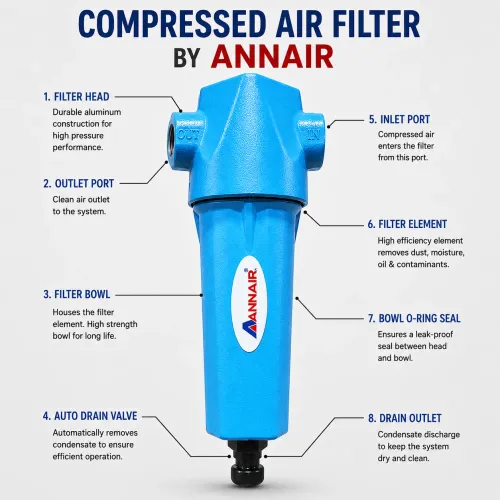
For plants running two or three shifts, a routine inspection every three months and a full service check annually is a reasonable baseline, though this can vary by ambient conditions and air quality. Filters upstream of the dryer should be checked more frequently since a clogged pre-filter reduces dryer efficiency and can shorten its service life.
6. Does Annair provide installation and commissioning support for automotive plants?
Yes. Annair Drychill Tech's team handles capacity assessment based on your actual plant air demand, along with installation guidance and after-sales service support across India and the UAE.
Get a Refrigerated Air Dryer Sized for Your Plant
Annair Drychill Tech India Pvt. Ltd. — Refrigerated Air Dryers, Desiccant Dryers, Water Chillers, and Compressed Air Filtration for Automotive and Industrial Manufacturing
WhatsApp Us: +91 90761 27777