
What Is an Auto Drain Valve, and Why Is It Used in Compressed Air Systems?
Compressed air systems are widely used in manufacturing plants, workshops, process industries, and a variety of industrial applications. But whenever atmospheric air is compressed, moisture can accumulate inside the system. If this condensate is not removed properly, it can affect equipment performance, reduce efficiency, and contribute to corrosion.
This is where an auto drain valve plays an important role.
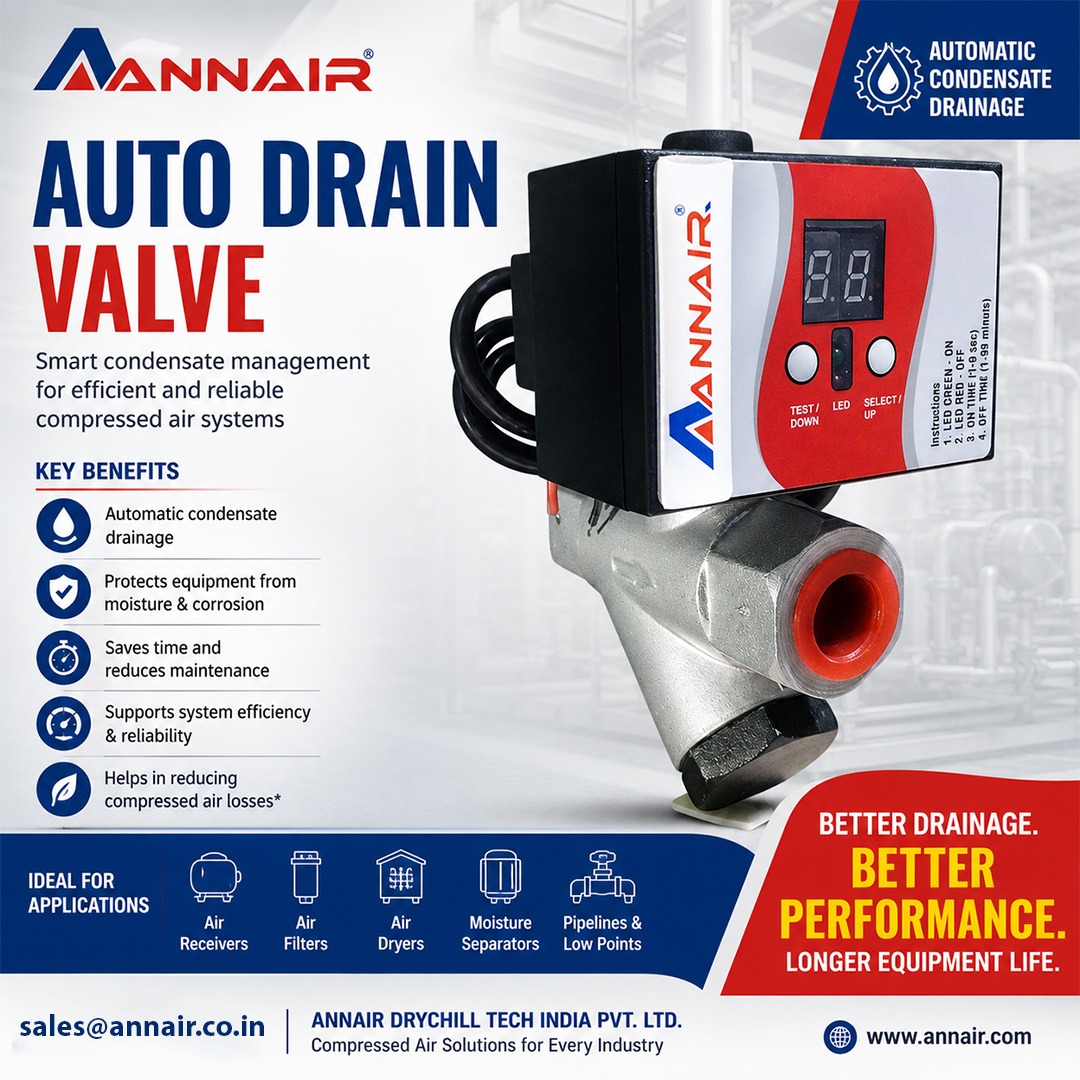
But what is an auto drain valve, and why is it used in compressed air systems? In simple terms, an auto drain valve is a device designed to automatically discharge accumulated condensate and moisture from compressed air equipment without requiring frequent manual intervention.
For businesses relying on clean, reliable compressed air, selecting an appropriate automatic drainage solution can help maintain system performance and protect downstream equipment.
What Is an Auto Drain Valve?
An auto drain valve, also called an automatic drain valve, is a component used in compressed air systems to remove collected condensate automatically.
During the compression process, moisture present in atmospheric air can condense inside components such as
Air receivers
Air compressors
Air dryers
Filters
Moisture separators
Distribution pipelines
Condensate collection points
An auto drain valve detects or responds to the accumulation of condensate and releases it from the system at predetermined intervals or when a specific level is reached, depending on its design.
This reduces the need for operators to manually open drain points and helps prevent condensate from remaining inside critical components.
Why Does Condensate Form in Compressed Air Systems?
Atmospheric air naturally contains water vapor. When air is compressed, its temperature, pressure, and moisture-handling capacity change. As the compressed air cools, some of the water vapor can condense into liquid water.
This condensate can collect at low points throughout the compressed air system.
If it is not removed, excessive moisture may contribute to:
Internal corrosion
Contamination of compressed air
Damage to pneumatic equipment
Poor performance of air tools
Reduced efficiency of air treatment equipment
Moisture-related production problems
An effective condensate drainage system is therefore an important part of compressed air management.
How Does an Auto Drain Valve Work?
The operating principle depends on the type of automatic drain valve.
Generally, the valve allows accumulated condensate to be discharged while minimizing the unnecessary loss of compressed air.
Some automatic drains operate based on a timer, while others use a level-sensing mechanism. Timer-controlled models open at preset intervals, whereas level-sensing drains can activate when condensate reaches a particular level.
A typical operating cycle involves:
Condensate collection: Moisture accumulates at a designated drainage point.
Detection or timing: The valve identifies the need for drainage based on its operating mechanism.
Valve activation: The drain opens automatically.
Condensate discharge: Accumulated liquid is released safely.
Valve closure: The valve closes after the drainage cycle.
The correct operating principle depends on the application, system design, condensate volume, pressure, and equipment being protected.
Where Are Auto Drain Valves Used?
Auto drain valves can be used at various points in a compressed air system.
1. Air Receivers
Air receiver tanks can collect significant amounts of condensate. An automatic drain can help remove accumulated moisture without requiring frequent manual draining.
2. Air Compressors
Moisture and condensate can accumulate around compressor-related components. Appropriate drainage helps support reliable operation and maintenance.
3. Air Dryers
Compressed air dryers remove moisture from air, but condensate can still be generated or collected within the air treatment process. Automatic drainage is commonly used to remove it.
4. Air Filters and Moisture Separators
Filters and separators can collect liquid water and other contaminants. An automatic drain helps discharge collected condensate.
5. Compressed Air Pipelines
Condensate can accumulate at low points in distribution networks. Automatic drainage can be incorporated at suitable collection points.
Key Uses of an Auto Drain Valve
The primary purpose of an auto drain valve is condensate removal, but it supports several aspects of compressed air system operation.
Automatic Condensate Removal
The valve eliminates the need for operators to manually drain condensate at every drainage point.
Protection of Compressed Air Equipment
Regular removal of moisture can help reduce exposure of equipment and components to accumulated water.
Improved System Hygiene
Removing collected condensate helps prevent excessive moisture from travelling further into the compressed air network.
Reduced Maintenance Intervention
Automation can reduce routine manual drainage tasks, particularly in systems with multiple drainage points.
Support for Reliable Operation
Keeping condensate under control can contribute to more consistent operation of compressed air equipment and downstream pneumatic devices.
Benefits of Using an Auto Drain Valve
Choosing the right automatic drain solution can provide several practical benefits.
1. Saves Time
Automatic drainage reduces the need for operators to repeatedly check and manually empty condensate collection points.
2. Helps Prevent Moisture-Related Problems
Excessive condensate can contribute to corrosion, contamination, and pneumatic equipment issues. Automatic drainage helps manage accumulated moisture.
3. Supports Equipment Protection
By removing condensate from receivers, filters, dryers, and other collection points, an automatic drain can help protect components from prolonged contact with water.
4. Reduces the Risk of Missed Drainage
Manual drains depend on regular operator attention. Automatic operation helps maintain a consistent drainage routine.
5. Suitable for Industrial Applications
Auto drain valves can be used in a wide range of compressed air applications, from manufacturing facilities and workshops to process industries.
6. Can Support Energy Efficiency
An appropriately selected and correctly functioning drain can help avoid unnecessary compressed-air losses associated with poorly managed drainage.
The actual energy impact depends on the drain design, operating conditions, maintenance, and overall compressed air system.
Types of Auto Drain Valves
Different compressed air applications may require different drainage technologies.
Timer-Based Auto Drain Valves
These valves open at predefined intervals for a specified duration.
Advantages:
Simple operating concept
Adjustable drainage intervals on suitable models
Commonly used in various compressed air applications
However, if the timer settings do not match the actual condensate generation rate, the valve may open too frequently or not frequently enough.
Zero-Loss or Level-Sensing Drain Valves
These systems are designed to discharge condensate based on its accumulation level rather than simply opening at fixed time intervals.
Potential advantages include:
Drainage based on actual condensate accumulation
Reduced unnecessary compressed-air loss
Efficient condensate management
The suitability of a zero-loss drain depends on system requirements and the specific valve design.
How to Select the Right Auto Drain Valve
Before choosing an automatic drain valve, consider the following factors:
Operating pressure: Ensure the valve is rated for the pressure range of your application.
Condensate volume: The drain should have sufficient capacity for the amount of condensate generated.
Connection size: Check compatibility with the equipment and existing drainage piping.
Temperature: Verify that the valve is suitable for the operating temperature.
Drainage mechanism: Choose between timer-based, level-sensing, or other technologies based on system requirements.
Installation environment: Industrial environments may expose components to dust, oil, vibration, or temperature variations.
Maintenance requirements: Consider accessibility, cleaning requirements, spare parts, and serviceability.
A properly selected drain valve should match the operating conditions rather than simply being chosen based on size or price.
Maintenance Tips for Auto Drain Valves
Although automatic drains reduce manual intervention, they still require periodic inspection.
Here are some useful maintenance practices:
Inspect the valve regularly for leakage or blockage.
Check electrical connections on electrically operated models.
Clean the drainage mechanism according to the manufacturer's instructions.
Verify that condensate is actually being discharged.
Inspect connected tubing and fittings for damage.
Check timer settings where applicable.
Look for excessive compressed-air leakage.
Replace worn components when required.
A drain that appears to operate automatically should not be assumed to be maintenance-free.
What Happens If Condensate Is Not Removed?
Leaving condensate inside a compressed air system can create several problems.
Water can contribute to corrosion inside storage vessels and pipelines. It can also reach pneumatic tools, valves, actuators, and other downstream equipment.
Depending on the application, excess moisture may lead to:
Corrosion
Equipment malfunction
Product contamination
Reduced pneumatic tool performance
Increased maintenance requirements
Shorter component service life
For applications requiring dry compressed air, condensate management should be considered alongside air filtration and drying.
Auto Drain Valve vs. Manual Drain Valve
A manual drain valve requires an operator to open and close the valve to remove accumulated condensate.
An auto drain valve performs this task automatically according to its operating mechanism.
| Feature | Manual Drain Valve | Auto Drain Valve |
|---|---|---|
| Operation | Manual | Automatic |
| Operator involvement | Regular | Reduced |
| Drainage consistency | Depends on the manual schedule | Based on programmed or sensed operation |
| Suitable for multiple drain points | More labor-intensive | More convenient |
| Maintenance | Simple but requires attention | Requires periodic inspection |
The appropriate choice depends on the size and design of the compressed air system, operating conditions, and maintenance practices.
Why Is an Auto Drain Valve Important for Industrial Compressed Air Systems?
Industrial compressed air systems often operate continuously and may have multiple points where condensate accumulates.
Manually monitoring every drain point can be inconvenient and may result in missed drainage. An automatic drain provides a practical way to manage condensate consistently.
For facilities focused on equipment reliability, air quality, maintenance efficiency, and effective compressed air management, automatic condensate drainage can be an important part of the overall system.
Frequently Asked Questions About Auto Drain Valves
1. What is an auto drain valve?
An auto drain valve is a device that automatically removes accumulated condensate from compressed air equipment and drainage points.
2. Why is an auto drain valve used in compressed air systems?
It is primarily used to remove moisture and condensate that forms during compression and cooling, helping manage water accumulation and reduce moisture-related problems.
3. Where is an automatic drain valve installed?
It can be installed on equipment such as air receivers, filters, dryers, moisture separators, and suitable low points in compressed air distribution systems.
4. Does an auto drain valve prevent moisture from forming?
No. The valve removes accumulated condensate; it does not itself prevent moisture from forming. Air dryers and other air-treatment equipment may be used when lower moisture levels are required.
5. How often should an auto drain valve be maintained?
Maintenance frequency depends on the valve type, operating conditions, condensate quality, and manufacturer's recommendations. Regular inspection is advisable.
6. Can an auto drain valve save compressed air?
Some drain technologies are specifically designed to minimize compressed-air loss. However, actual savings depend on the drain design, settings, condition, and application.
7. How do I choose the right auto drain valve?
Consider operating pressure, condensate volume, temperature, connection size, drainage technology, installation conditions, and maintenance requirements.
8. Can auto drain valves be used with air dryers and filters?
Yes. Automatic drains are commonly used with compressed air treatment equipment such as filters, separators, and dryers to remove collected condensate.
Conclusion
An auto drain valve is an important component for effective condensate management in compressed air systems. By automatically removing accumulated moisture from air receivers, filters, dryers, separators, and other suitable drainage points, it can reduce manual intervention and help protect compressed air equipment from moisture-related issues.
Selecting the correct drain valve requires consideration of the system's pressure, condensate volume, temperature, installation environment, and drainage requirements.
For businesses looking for reliable compressed air and air-treatment solutions, understanding condensate management is an important step toward maintaining an efficient and dependable system.
Annair Drychill Tech India Pvt. Ltd. provides solutions for compressed air and air-treatment applications. Contact our team to discuss your compressed air requirements and identify a suitable condensate drainage solution for your system.