
Maintaining the Ideal Flush: The Role of Dehumidifiers in Mushroom Farming
Mushroom cultivation is an exercise in precision. While these fungi thrive in high-humidity environments, there is a razor-thin line between "optimal moisture" and "crop-destroying saturation." In a commercial grow room, controlling the dew point and relative humidity (RH) is the difference between a bountiful harvest and a total loss due to mold or bacterial blotch.
Why Humidity Control is Critical for Fungi
During the pinning and fruiting stages, most mushroom varieties require RH levels between 80% and 95%. However, as mushrooms "breathe," they release moisture through transpiration. Without active dehumidification, the air becomes stagnant and over-saturated.
Evaporation Trigger: For a mushroom to grow, moisture must evaporate from its surface. This evaporation pulls nutrients from the substrate into the mushroom. If the air is 100% saturated, evaporation stops, and growth stalls.
Disease Prevention: Excessively wet surfaces are breeding grounds for Pseudomonas tolaasii (bacterial blotch) and various competitive molds (like Green Mold).
Cap Quality: Controlled dehumidification ensures the caps remain firm and have the appropriate color and texture for market standards.
Choosing the Right Technology for the Grow Room
Because mushroom farms are unique environments—often cool and extremely damp—standard residential units won't suffice.
1. Refrigerant Dehumidifiers (Industrial Grade)
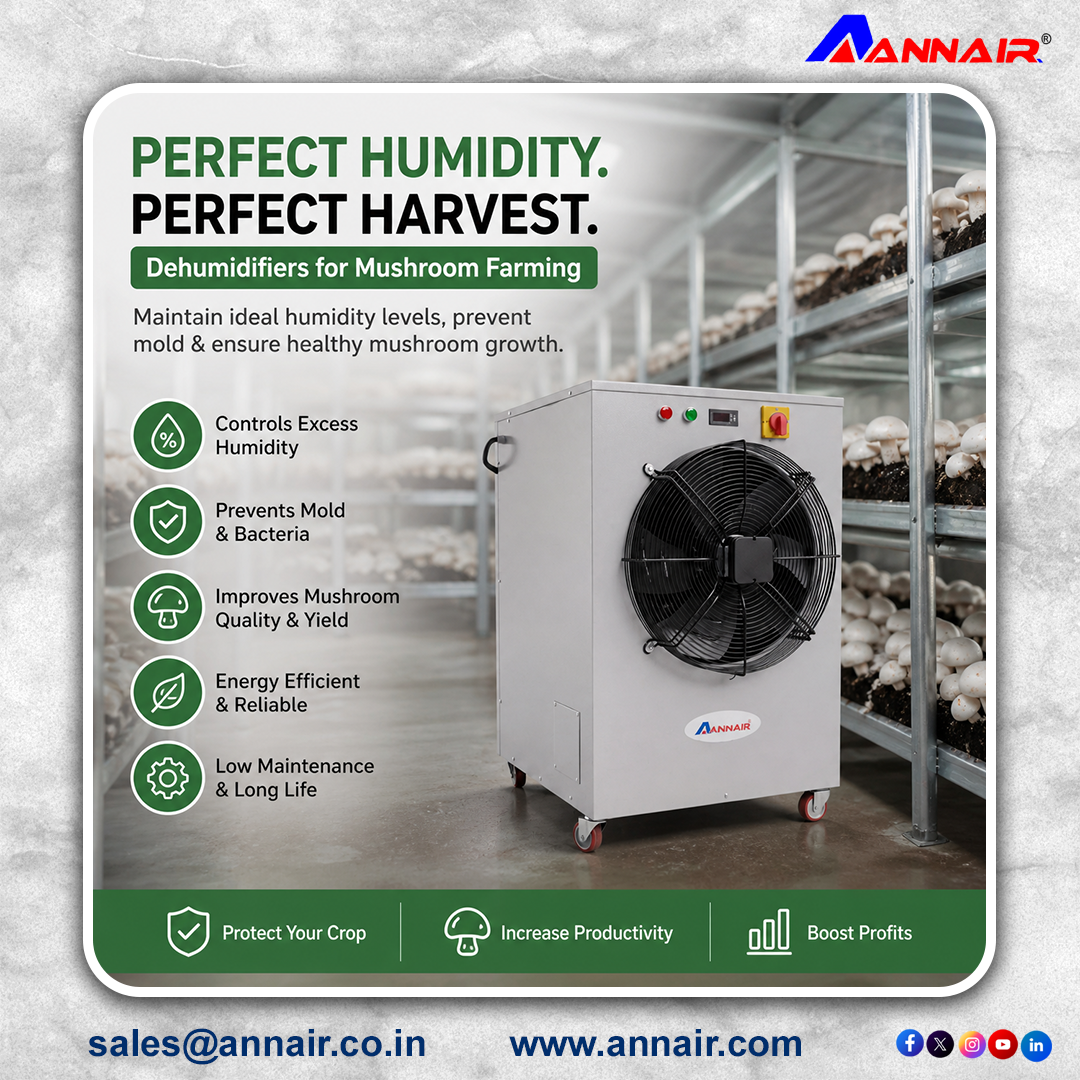
In many tropical or temperate climates, industrial refrigerant units are the workhorse of the farm. They are highly effective at pulling massive amounts of water from the air during the peak fruiting phase.
Pro Tip: Look for units with epoxy-coated coils to prevent corrosion from the high CO2 levels and spores often present in grow rooms.
2. Desiccant Dehumidifiers
For specialized crops that require cooler temperatures (like certain Oyster varieties or Shiitake), desiccant units are superior. Since they don't rely on cooling to remove water, they can maintain a precise RH even when the grow room is kept at 10°C to 15°C.
Strategic Implementation: Beyond the Machine
To get the most out of your climate control setup, consider these three factors:
Integrated Sensors: Your dehumidifier should be linked to a high-accuracy humidistat. In a mushroom farm, sensors can get "drift" due to the constant moisture, so regular calibration is essential.
Airflow and Uniformity: A dehumidifier only dries the air it can reach. Use circulation fans to ensure there are no "dead zones" where pockets of high-humidity air can settle and cause localized mold outbreaks.
The Dry-Back Period: Many successful growers use a "dry-back" strategy after watering or misting. By briefly dropping the RH to 80%, you encourage a burst of transpiration that strengthens the mushroom tissue before returning to higher humidity for expansion.
Summary: The Technical Advantage
Managing a mushroom farm is about managing the vapor pressure deficit (VPD). By utilizing industrial-grade dehumidification, you aren't just "drying the air"—you are creating a dynamic environment that forces the mushroom to feed, grow, and resist disease.
Ready to upgrade your grow room climate? Focus on high-capacity, corrosion-resistant units that can handle the heavy lifting of a peak flush.
📞 Contact Us Today!
Looking for the right dehumidifier for mushroom farming?
👉 Get expert guidance & best pricing
📱 Call/WhatsApp: +91 9076127777
📧 Email: sales@annair.co.in
🌐 Visit: www.annair.co.in
ANN AIR – Perfect Humidity, Perfect Harvest 🌱