
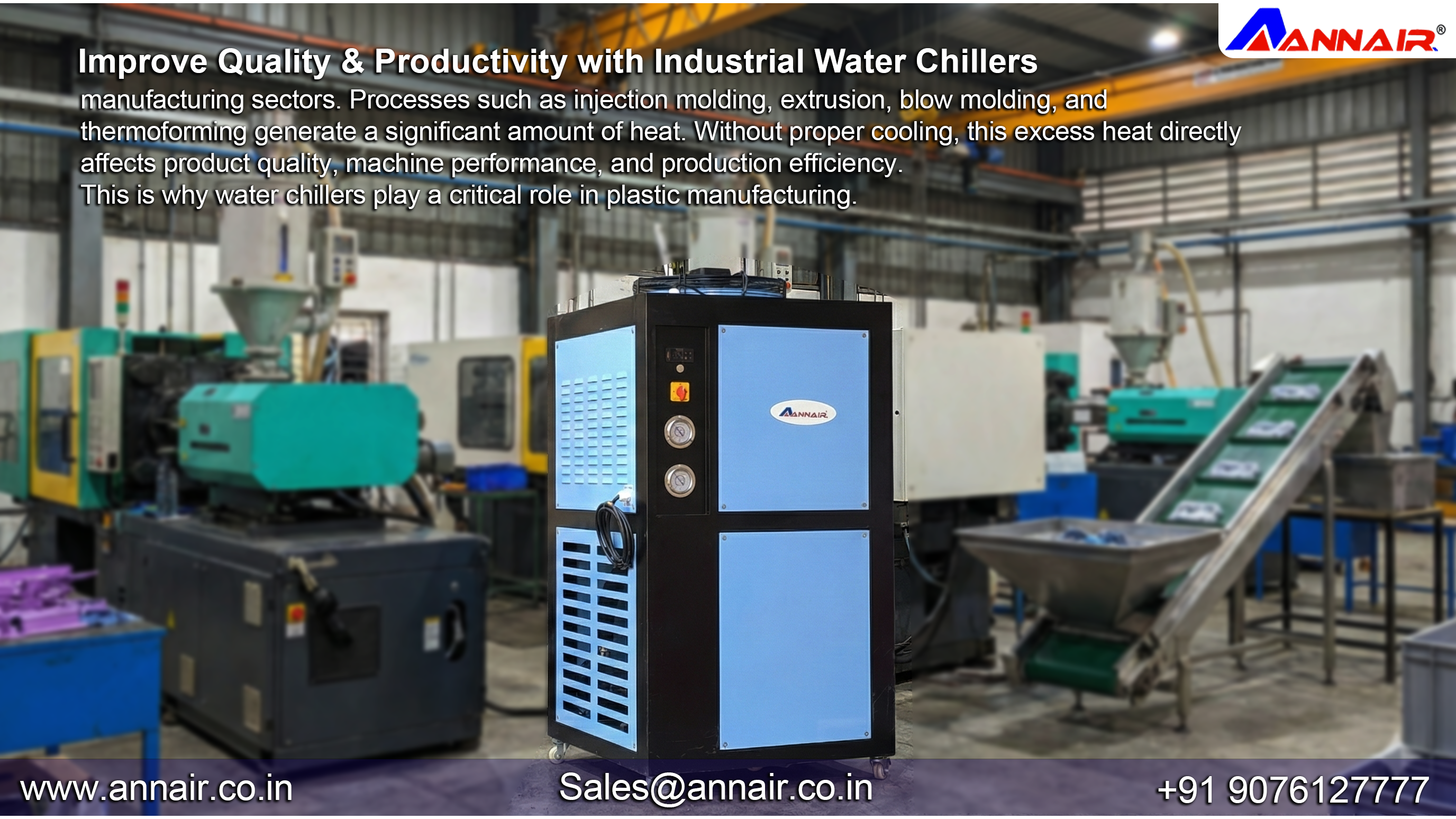
Why Water Chillers Are Essential in the Plastic Industry
Water Chillers plastic industry is one of the most temperature-sensitive manufacturing sectors. Processes such as injection molding, extrusion, blow molding, and thermoforming generate a significant amount of heat. Without proper cooling, this excess heat directly affects product quality, machine performance, and production efficiency.
This is why water chillers play a critical role in plastic manufacturing. An industrial water chiller ensures consistent temperature control, faster cycle times, and long-term operational reliability, making it an essential component of any plastic processing plant.
What Is a Water Chillers ?
A water chiller is an industrial cooling system designed to remove heat from machines, molds, and production processes by circulating chilled water. This chilled water absorbs excess heat from plastic processing equipment and transfers it away, maintaining a stable operating temperature throughout the production cycle.
In plastic manufacturing, even minor temperature fluctuations can lead to defects, higher rejection rates, and unexpected downtime. Water chillers help eliminate these risks by ensuring precise temperature control.
Why Temperature Control Is Critical in Plastic Manufacturing
Plastic processing involves melting raw materials at high temperatures and cooling them in a controlled manner to achieve the desired shape, strength, and finish. Inefficient or uneven cooling can result in:
Warping or shrinkage of plastic parts
Poor surface finish
Dimensional inaccuracies
Longer production cycles
Increased machine wear and tear
A reliable water chiller system ensures uniform and precise cooling, which is essential for maintaining consistent product quality and meeting industry standards.
Key Benefits of Water Chillers in the Plastic Industry
Improved Product Quality
Product quality in plastic manufacturing depends heavily on controlled cooling. Water chillers maintain a stable mold and process temperature, resulting in:
Uniform cooling of plastic components
Better surface finish
Reduced rejection and scrap rates
Consistent temperature control ensures every product meets the same quality benchmarks.
Faster Production Cycle Time
In plastic manufacturing, cycle time directly impacts profitability. Faster cooling allows molds to solidify quickly, reducing overall cycle time.
With an industrial water chiller:
Cooling time is minimized
Production speed increases
Higher output is achieved per shift
This boosts productivity without compromising quality.
Protection Against Machine Overheating
Plastic processing machines such as injection molding machines, extruders, and hydraulic systems operate continuously and generate substantial heat. Excess heat can cause:
Machine breakdowns
Frequent maintenance
Reduced equipment lifespan
A water chiller keeps machine temperatures under control, protecting critical components and extending the life of costly machinery.
Energy Efficiency and Cost Savings
Modern industrial water chillers are designed for high energy efficiency. Compared to conventional cooling methods, they:
Reduce power consumption
Deliver optimal cooling with lower energy usage
Lower overall operating costs
By preventing overheating and production losses, water chillers also reduce hidden costs such as downtime and rework.
Consistent and Continuous Production
Plastic manufacturing often runs 24/7, and any temperature imbalance can cause costly interruptions. A water chiller ensures:
Continuous cooling
Stable production conditions
Reliable operation even during peak loads
This consistency is crucial for meeting delivery schedules and customer commitments.
Applications of Water Chillers in the Plastic Industry
Water chillers are widely used across various plastic processing applications, including:
Injection molding machine cooling
Extrusion line cooling
Blow molding machine cooling
Mold and die temperature control
Hydraulic oil cooling
Each application requires precise temperature regulation, which only an industrial water chiller can provide efficiently.
Air-Cooled vs. Water-Cooled Chillers for Plastic Plants
Plastic manufacturers can choose between air-cooled and water-cooled chillers based on plant size and cooling requirements.
Air-Cooled Chillers:
Easy installation
Suitable for small to medium plastic units
Water-Cooled Chillers:
Higher efficiency
Ideal for large-scale plastic manufacturing plants with heavy cooling loads
Selecting the right type ensures maximum efficiency and long-term performance.
How to Choose the Right Water Chiller for Plastic Manufacturing
When selecting a water chiller, consider the following factors:
Required cooling capacity (TR)
Type of plastic process
Ambient temperature conditions
Energy efficiency rating
Reliability and after-sales support
A properly sized and well-designed water chiller ensures smooth operations and maximum return on investment.
Conclusion
In the plastic industry, water chillers are not optional—they are a necessity. From improving product quality and reducing cycle time to protecting machinery and saving energy, water chillers play a vital role in efficient and profitable plastic manufacturing.
Investing in a high-quality industrial water chiller helps plastic manufacturers achieve consistent production, superior quality, and long-term cost savings, making it an essential solution for modern plastic processing plants.
In the plastic industry, water chillers are not optional—they are a necessity. From improving product quality and reducing cycle time to protecting machinery and saving energy, water chillers play a vital role in efficient and profitable plastic manufacturing.
Investing in a high-quality industrial water chiller helps plastic manufacturers achieve consistent production, superior quality, and long-term cost savings, making it an essential solution for modern plastic processing plants.
📞 Contact Us
Do you have questions about our air dryers, chillers, or compressed air solutions?
Our team is here to assist you with product details, quotations, or technical support.
📞 Phone: +91-9076127777
📧 Email: sales@annair.co.in
🌐 Website: www.annair.co.in
🔗 Follow Us.
🌐 Website: www.annair.co.in
📘 Facebook: facebook.com/annair.FB
🐦 Twitter (X): twitter.com/annair.X
📸 Instagram: instagram.com/annair.ig
▶️ YouTube: youtube.com/annair.yt