
Panel AC vs Air Conditioner: Which Cooling System Is Better for Electrical Panels?
Confused between a panel AC and a regular air conditioner for your electrical panel? Compare cooling methods, IP ratings, and selection factors for Mumbai industries. If you run a manufacturing unit anywhere between Bhiwandi and Taloja, you already know what Mumbai's humidity does to electrical panels. VFDs trip on hot afternoons, and control cabinets that were fine in winter start throwing nuisance faults by April. The question that comes up on the shop floor is simple: why not just fit a normal air conditioner on the panel? It seems cheaper and easier to source. But a panel AC and a household or commercial air conditioner solve two different problems, and mixing them up usually costs more in downtime than it saves in purchase price.
What Is a Panel AC and How Is It Different from a Regular Air Conditioner
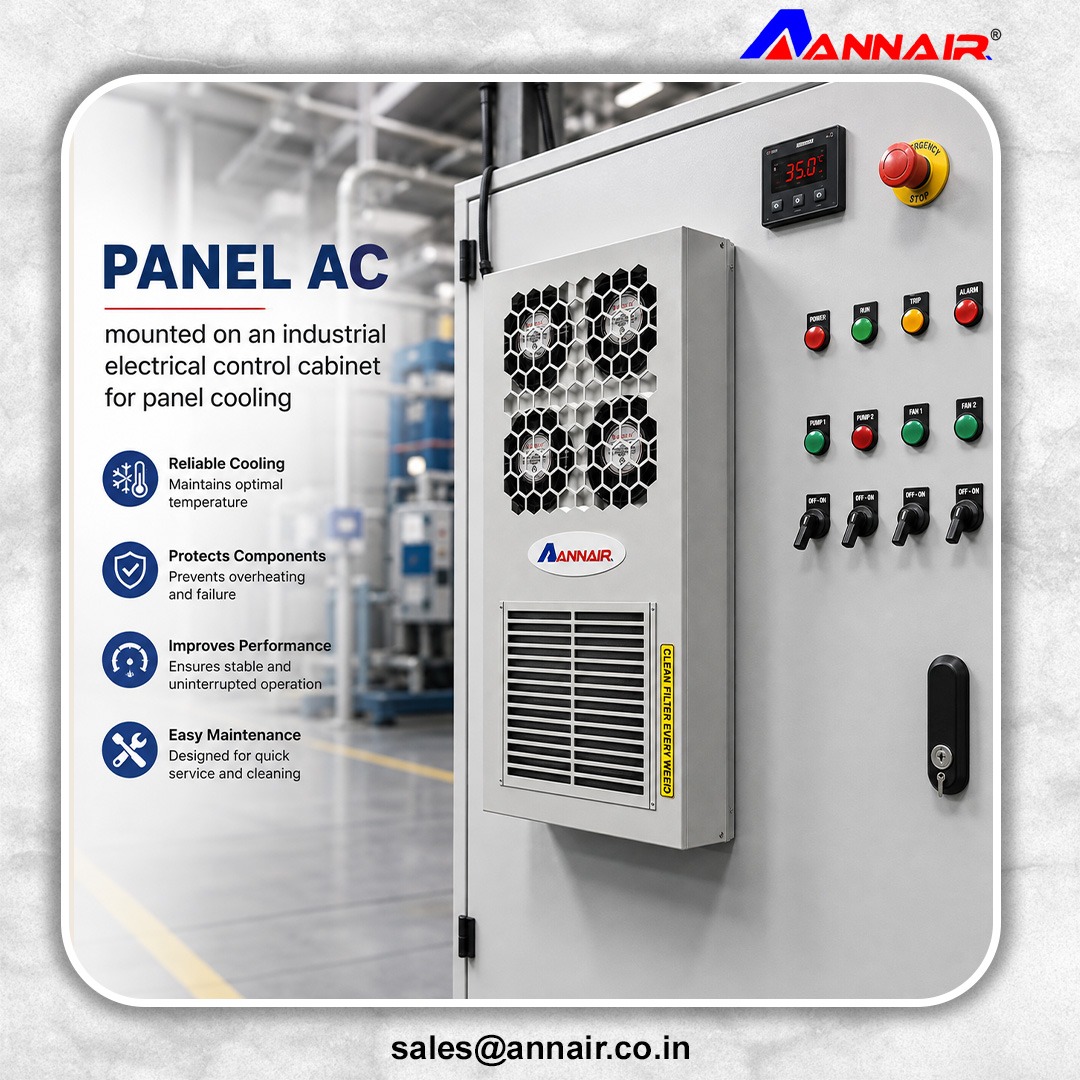
A panel AC is a compact, sealed cooling unit mounted directly on an electrical panel or control cabinet. It circulates air only inside the closed cabinet, cooling it and rejecting heat outside without ever exposing the enclosure to the surrounding factory air. A regular split or window AC is built to cool a room—it pulls in and pushes out room air freely, using filters and open grilles that were never designed to handle metal dust, oil mist, or coolant vapor. Electrical panels don't need room-comfort cooling. They need heat removed from a sealed metal box while keeping dust and moisture completely outside.
Why a Conventional AC Falls Short on Electrical Enclosures
A split AC indoor unit isn't sealed against the cabinet, so it can't maintain closed-loop airflow. Dust from grinding or welding gets pulled toward the electronics instead of staying out. Condensate drainage isn't designed for a vertical panel mount, and a domestic AC's compressor isn't rated for continuous duty near vibrating machinery. Cooling the whole room with a split AC instead helps a little, but it's slow, expensive, and still doesn't stop dust settling on busbars when doors or exhausts stay open.
Why Sealed Cooling Matters for Dust and Humidity
Most industrial panels carry an IP54 or IP55 rating, built to keep dust and light water spray out. An electrical enclosure AC works on the same sealed principle—it mounts into a cutout on the panel and exchanges heat through a closed refrigeration loop, so cabinet air is never exposed outside. This matters in industrial belts like Bhiwandi, Dombivli, and Ambernath, where dust and overspray are constant. Fit an unsuitable AC and you defeat the purpose of a sealed panel altogether.
Where Panel ACs Are Used
Panel AC units are common wherever heat-sensitive electronics sit in sealed cabinets — CNC and VMC machine controls, VFD and servo drive panels across automation lines in Thane and Navi Mumbai, MCC panels in process plants, and OEM machine builds needing compact panel-mounted cooling rather than room air conditioning.
Selecting the Right Panel AC
Before buying, work out the basics rather than choosing on price alone:
- Heat load inside the panel — total wattage from drives, transformers, and components
- Ambient temperature at site—a panel near a furnace needs more margin than one in an air-conditioned room
- Mounting type — side, roof, or through-door, depending on cabinet layout
- IP rating compatibility — the AC should match the enclosure's existing protection level
- Cooling capacity (CFM/watts) — undersizing forces continuous running and shortens compressor life
Suppliers such as ANNAIR Drychill Tech (India) Pvt. Ltd., based in Mumbai, manufacture electrical panel coolers built specifically for this sealed, panel-mounted duty rather than adapted room ACs—worth checking when comparing spec sheets rather than price alone.
Common Problems in Control Panel Cooling — and Fixes
Condensation dripping inside the cabinet: Usually an oversized unit short-cycling before it can dehumidify properly. Match capacity to actual heat load and check the drain routing.
Frequent compressor short-cycling: Often a sizing issue or an over-aggressive thermostat setting — check real heat dissipation figures rather than guessing.
Dust on the condenser coil: Even sealed units need the external coil cleaned periodically, or heat rejection efficiency drops over time.
Panel still overheating despite the AC running: Check degraded door seals, unsealed cable gland openings, or airflow blocked by internal wiring congestion.
FAQs
Can I use a normal split AC to cool an electrical panel? Not reliably — it isn't sealed for panel mounting, doesn't handle industrial dust well, and isn't built for continuous duty near vibrating equipment.
What size panel AC do I need for my control panel? It depends on the actual heat dissipated by the components inside, plus ambient temperature at the site. A rough panel-size estimate isn't accurate enough — a proper heat load calculation is.
Why does my panel AC form water droplets inside the cabinet? Usually an oversized unit is short-cycling before it can dehumidify the air, or a drain line is not clearing condensate correctly.
What IP rating should a panel AC have for a dusty factory near Bhiwandi or Ambernath? Match it to your panel's existing rating — commonly IP54 or IP55 — so the cooling unit doesn't become the weak point in an otherwise sealed enclosure.
How is a panel AC different from a cooling fan or heat exchanger? A fan or heat exchanger only helps when outside air is cooler and cleaner than inside the panel. A panel AC uses active refrigeration, so it can bring cabinet temperature below ambient even in Mumbai's heat and humidity.
Conclusion
For sealed electrical panels, a panel AC does a job a conventional room air conditioner isn't built for—closed-loop cooling that keeps dust, moisture, and heat separate from the equipment inside. If you're running CNC lines, automation panels, or MCC rooms anywhere in Mumbai, Thane, Navi Mumbai, or the industrial belts around Bhiwandi and Taloja, sizing and selecting the right unit properly will save more in avoided downtime than the unit itself typically costs. When in doubt, get the panel's actual heat load calculated first — it's the factor that decides whether the cooling system keeps up.
📞 Contact Us Our team is here to assist you with product details, quotations, or technical support.
📞 Phone: +91-9076127777
📧 Email: sales@annair.co.in
🌐 Website: www.annair.com