
Best Industrial Water Chillers for Manufacturing Plants in India: A Complete Buying Guide
Your production line just stopped. Again. The culprit? An undersized chiller that can't keep pace with your machine's cooling load. It's a frustrating, expensive problem—and one that thousands of manufacturing plants across India face every single summer.
If you're searching for the best industrial water chillers for manufacturing plants in India, you're probably dealing with one of three things: overheating equipment, rising energy bills, or a chiller that's simply outgrown your production capacity. This guide walks you through exactly what to look for, which chiller type fits your process, and how to avoid the sizing mistakes that cost Indian manufacturers lakhs every year.
No fluff. Just the engineering facts you need to make a confident decision.
Why Chiller Selection Matters More in India
India isn't Germany. Or Japan. Our ambient temperatures swing wildly—45°C summers in Rajasthan, humid 38°C conditions in Chennai, and cooler winters up north. A chiller sized for European climate data will underperform here. Badly.
Add to that voltage fluctuations, dusty industrial environments, and hard water in many regions. Your chiller needs to survive all of it, every day, for years. That's the real-world context that generic buying guides ignore.
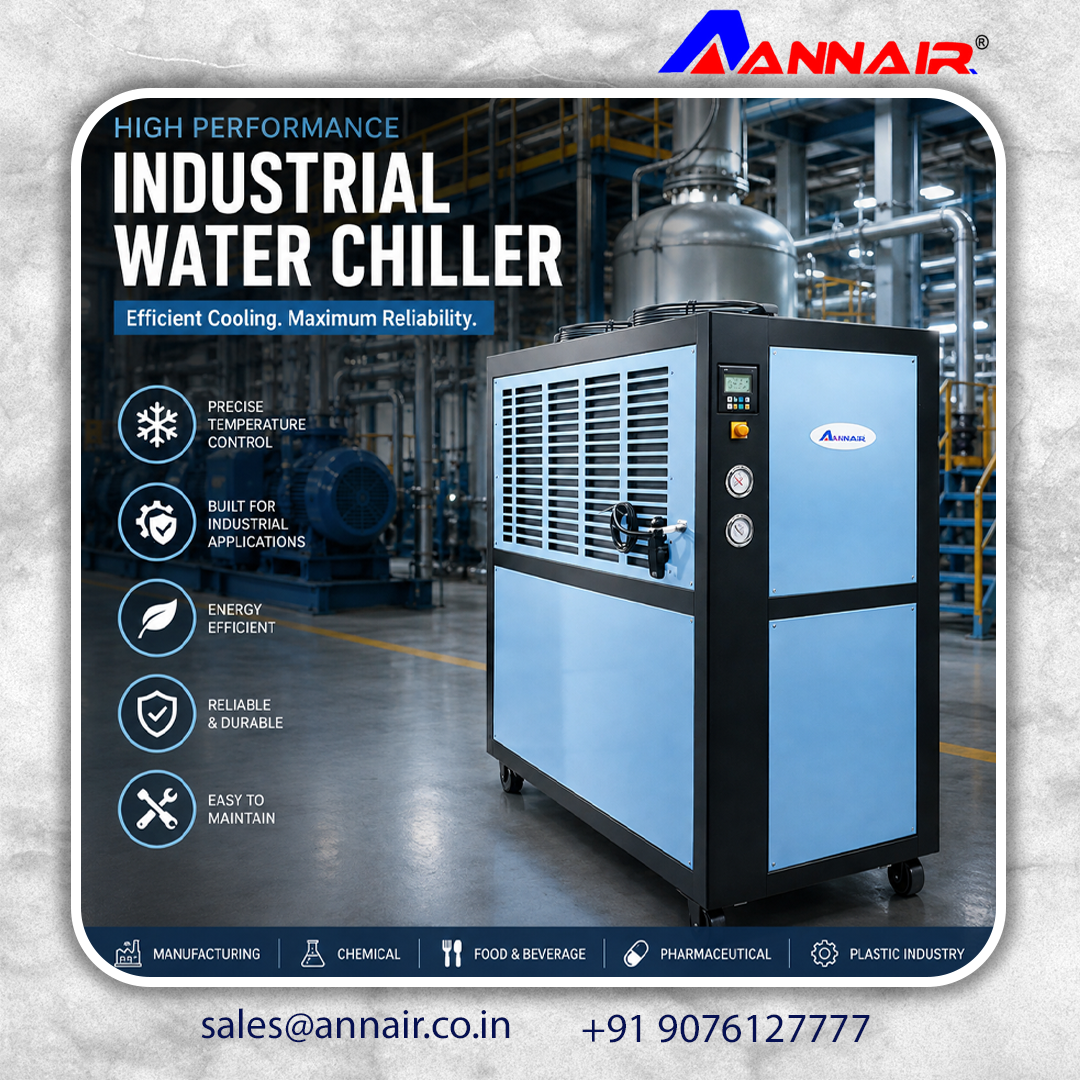
Industrial water chillers fall into two broad families—air-cooled and water-cooled—and within these, scroll compressor and screw compressor models. The right choice depends on your process load, ambient conditions, water availability, and duty cycle. Undersizing is the #1 cause of premature failure in Indian plants.
Air-Cooled vs. Water-Cooled Chillers: Which One Fits Your Plant?
This is the first fork in the road. Get it wrong, and everything downstream — energy costs, maintenance, footprint — gets harder.
Air-cooled chillers reject heat directly to the atmosphere through a condenser fan. No cooling tower. No make-up water. Simple installation. They work well for plants with limited water access or where water treatment costs are a concern. The tradeoff? Slightly lower efficiency in extreme heat, and they need decent ventilation space.
Water-cooled chillers use a cooling tower to reject heat, which makes them more energy-efficient — especially at higher tonnage. Plastics processing, pharma manufacturing, and large-scale food production plants often prefer these. But they need consistent water supply and regular tower maintenance. Skip that, and scaling becomes a real headache.
| Factor | Air-Cooled Chiller | Water-Cooled Chiller |
|---|---|---|
| Installation | Simple, no cooling tower | Requires tower + pump setup |
| Water Requirement | Minimal | Continuous make-up water needed |
| Energy Efficiency | Good, drops in extreme heat | Higher, especially above 20TR |
| Best For | Small-mid plants, water-scarce areas | Large plants, continuous process cooling |
| Maintenance | Lower, fewer moving parts | Higher, tower cleaning required |
Scroll vs Screw Compressor Chillers
Here's where a lot of buyers get confused. Both technologies work. But they're built for different jobs.
Scroll compressor chillers are compact, reliable, and cost-effective for capacities up to roughly 30-40TR. They handle variable loads gracefully and are easier to service. Most injection molding units, small pharma batches, and laser cutting setups run comfortably on scroll-based systems.
Screw compressor chillers step in when tonnage climbs higher—think 50TR and beyond. They offer better part-load efficiency at scale and are the go-to for continuous, heavy-duty process cooling: large chemical plants, bulk drug manufacturing, and big injection molding operations running multiple shifts.
Choosing between them isn't just about tonnage. It's about your duty cycle, load variation, and how critical uptime is to your process.
Common Sizing Mistakes Indian Manufacturers Make
We've walked into dozens of plants where the chiller was mismatched from day one. A few patterns keep repeating.
Sizing for winter, not summer. Many buyers size based on average conditions. That fails the moment ambient temperature spikes in April and May.
Ignoring process heat load growth. Plants add machines. Nobody recalculates chiller capacity. Then everything runs hot.
Choosing the cheapest quote. Lower upfront cost often means thinner copper, weaker compressors, and higher failure rates within 2-3 years. It's a false economy.
Skipping water quality checks. Hard water without proper treatment scales up heat exchangers fast, quietly killing efficiency long before anyone notices.
Always size your chiller against your peak summer ambient temperature and maximum simultaneous heat load—not average conditions. Add a safety margin of 10-15% for future capacity expansion. A proper heat load calculation, done by an experienced OEM, prevents 90% of the failures we see in the field.
What to Look for in an Industrial Water Chiller Manufacturer
Not every supplier builds for Indian conditions. Before you finalize a vendor, check these points.
- Tropicalized design — components rated for high ambient temperature and humidity, not adapted from European specs.
- Branded compressors — Copeland, Danfoss, or Bitzer, with clear warranty documentation.
- Microprocessor-based controllers — for precise temperature control and remote monitoring.
- After-sales service network — spare parts availability and response time matter more than the sales pitch.
- Custom engineering capability — your process is unique. A one-size-fits-all chiller rarely performs well long-term.
This is exactly where OEM buyers and end users differ in priority. OEMs care about compact footprint and integration flexibility for their machines. End users care about the total cost of ownership and uptime. A good manufacturer designs for both.
Industries That Rely on Industrial Water Chillers
Plastic injection molding. Pharmaceutical manufacturing. Laser and CNC machining. Food and beverage processing. Electroplating. Printing and packaging. Each of these processes generates heat that must be removed precisely — too little cooling, and product quality suffers; too much, and energy costs spiral.
Across all of them, one truth holds. The chiller isn't a support system. It's part of the production line. Treat it like one.
Final Thoughts on Choosing the Best Industrial Water Chiller for Your Plant
There's no universal "best" industrial water chiller for manufacturing plants in India. There's only the best chiller for your specific process, your ambient conditions, and your growth plans. Get the sizing and the technology right, and it becomes an invisible, reliable part of your operation for the next 15-20 years. Get it wrong, and you'll be firefighting every summer.
The smartest move you can make right now? Get your heat load calculated properly, by people who understand Indian industrial conditions, before you buy anything.
Need the Right Water Chiller for Your Plant?
Annair Drychill Tech designs and manufactures industrial water chillers built for Indian operating conditions—air-cooled, water-cooled, scroll, and screw compressor systems custom-engineered for your process load.