
Best Panel AC for Server Room: How to Stop Your PLC and VFD Panels from Cooking Themselves
If you've ever opened a control panel and felt that blast of hot, dusty air hit your face, you already know the problem. Heat kills electronics. Slowly, then all at once. And when your VFDs and PLCs are packed into a tight enclosure with no proper cooling, you're not running equipment. You're running a countdown.
We get calls almost every week from plant engineers who've had a VFD trip out mid-shift or a PLC start throwing random faults for no obvious reason. Nine times out of ten, it comes down to one thing: temperature. Finding the best panel AC for server rooms and automation enclosures isn't a nice-to-have anymore. It's the difference between a production line that runs and one that doesn't.
Let's get into why this happens, what it costs you, and how the right panel cooling setup fixes it for good.
Key Takeaways
- Heat and dust are the top two silent killers of VFD panels and PLC-based control systems.
- A standard AC unit isn't built for panel duty. Sealed, precision panel AC units are.
- Precise temperature control keeps components inside their rated operating range, which cuts down failure rates significantly.
- The right panel AC pays for itself through fewer breakdowns, less downtime, and longer equipment life.
- Sizing and placement matter as much as the AC itself. Get both wrong, and even a good unit underperforms.
Why VFD and PLC Panels Overheat in the First Place
Automation panels are dense. You've got VFDs generating heat from switching losses; PLCs running continuously; relays; contactors; wiring—all crammed into a metal box that's usually mounted against a wall or inside a shed with poor airflow.
Add dust. Add humidity, especially if you're near Mumbai, Chennai, or coastal UAE sites like Jebel Ali or Sharjah. Add ambient temperatures that hit 40°C-plus for half the year. Now that panel isn't just warm. It's an oven.
Here's the part most people miss: VFDs don't fail immediately when they overheat. They derate first. Output drops. Efficiency drops. Then, over weeks or months, capacitors degrade faster than they should. One day, the drive just won't start. And you're left explaining unplanned downtime to a plant manager who wants answers.
The Real Cost of Ignoring Panel Temperature
- Unplanned downtime—every hour a VFD-driven line is down costs real money, not just in lost output but in overtime to catch up.
- Shortened component life — electrolytic capacitors in VFDs lose roughly half their lifespan for every 10°C rise above rated temperature.
- False fault trips — PLCs and drives throw overtemperature errors that stop production even before actual damage occurs.
- Dust-related short circuits — open ventilation lets in conductive dust, which is a fire and failure risk in electrical panels.
None of this is dramatic. It's just physics. And it's completely preventable with the right cooling approach.
What Makes a Panel AC Different from a Regular Split AC
This is where a lot of OEMs and end users go wrong. They think any AC unit thrown near the panel will do. It won't. A regular split AC cools a room. It's not designed to be mounted directly on a sealed enclosure, and it definitely isn't built to keep dust, moisture, and corrosive air out of sensitive electronics.
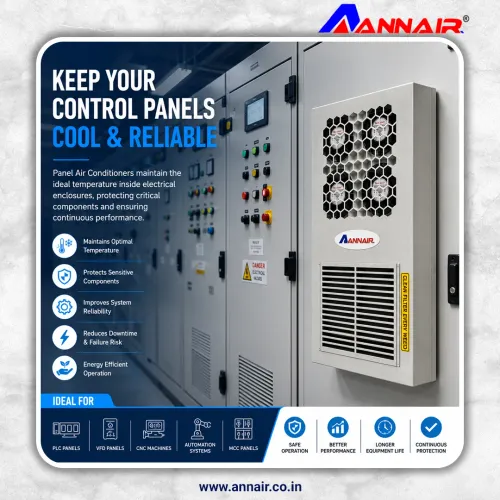
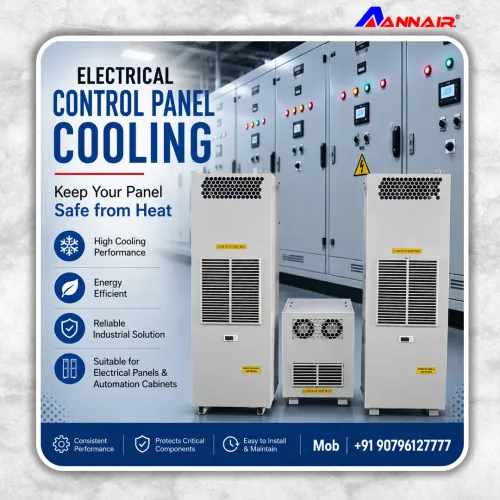
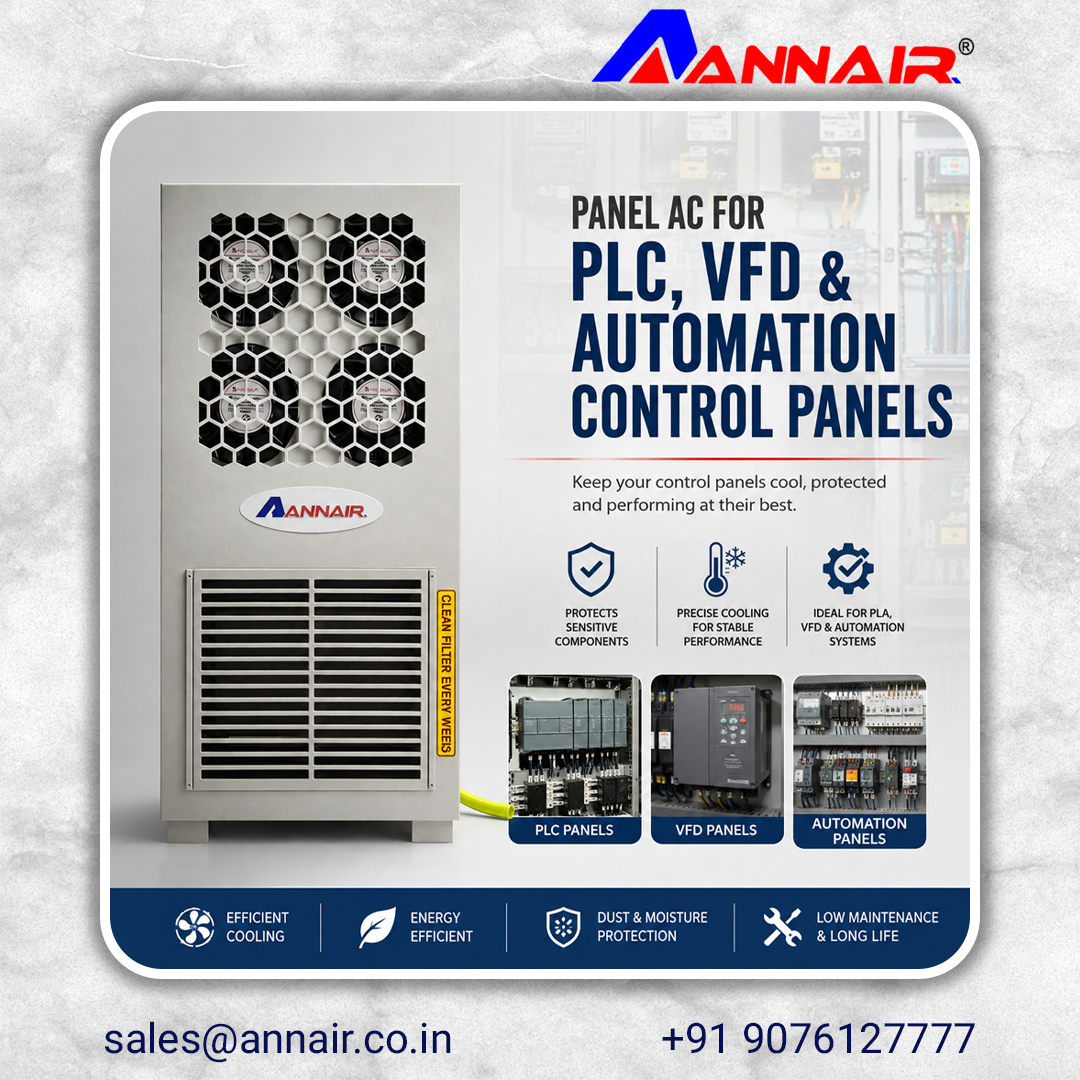
A proper electric panel AC is a closed-loop system. It cools the air inside the enclosure without ever exchanging it with the outside environment. No dust gets in. No humidity gets in. Just clean, temperature-controlled air circulating around your VFDs, PLCs, and drives.
| Feature | Standard Room AC | Annair Panel AC |
|---|---|---|
| Cooling Loop | Open, exchanges room air | Sealed, closed-loop system |
| Dust & Moisture Ingress | High risk | Sealed enclosure, IP-rated mounting |
| Temperature Precision | General comfort cooling, +/- wide range | Tight control suited to electronics tolerance |
| Mounting | Wall or window, not panel-rated | Direct panel/enclosure mount |
| Built For | Human comfort in rooms | VFD, PLC, server room & control panel protection |
That precision matters more than people expect. Electronics don't need a "cool room." They need a stable, predictable range. Swing too cold and you risk condensation. Swing too warm, and you're back to derating and premature failure. Precise temp control is really the whole game here — it's what separates a panel that runs for ten years from one that limps along for two.
Not sure what capacity your VFD panel or server room actually needs? We'll help you size it right the first time.
Contact Us for a Free Panel Cooling AssessmentSizing a Panel AC for VFD, PLC, and Server Room Setups
Undersizing is the most common mistake we see. An OEM builds a panel, adds a VFD or two, and picks whatever AC unit was used on the last project — without recalculating heat load. Then it fails on-site during summer, and everyone's confused why.
Heat load depends on a few things:
- Total wattage dissipated by VFDs, PLCs, transformers, and other heat-generating components inside the panel.
- Ambient temperature at the installation site — a panel in a Dubai warehouse needs more headroom than one in an air-conditioned Pune facility.
- Enclosure size, material, and how sealed it actually is.
- Solar loading, if the panel sits outdoors or near a window.
We size every unit against real heat load numbers, not guesswork. That's the whole point of getting this right the first time—you don't want to be adding a second AC unit six months after commissioning because the first one was underspecified.
Server Room Panels Need Even Tighter Control
If we're talking about a dedicated server room or a networking/automation control room, the stakes go up. Servers, switches, and industrial PCs are even less forgiving of temperature swings than a VFD. A few degrees over spec, sustained for weeks, and you'll start seeing drive failures, memory errors, and shortened hardware lifespans across the board.
This is exactly why "any AC will do" thinking doesn't hold up. You need a unit that holds a tight band, runs reliably 24/7, and doesn't introduce moisture or dust into a room full of sensitive gear.
What OEMs and Panel Builders Should Look For
If you're building panels for clients—whether it's a machine builder, a systems integrator, or an EPC contractor—your reputation rides on the panel working, not just on day one, but for years. A few things worth checking before you finalize a supplier:
- Corrosion-resistant construction — especially critical for coastal and Gulf installations where salt air eats through cheap components fast.
- Compressor reliability — this is the heart of the unit; a weak compressor means early replacement and unhappy end clients.
- Compact footprint—panel space is expensive real estate; the AC shouldn't eat into room needed for other components.
- Easy serviceability — filters and coils that are simple to access mean less downtime for maintenance.
- Consistent supply and support — if you're building panels at volume, you need a manufacturer who won't leave you waiting on lead times.
We've built our panel AC range around exactly these points, because we've heard the same complaints from OEMs across India and the UAE for years. Undersized units. Poor after-sales support. Components that corrode within a season near the coast. It's frustrating and, honestly, avoidable.
Building panels at scale or needing a reliable long-term supplier? Let's talk specs, lead times, and pricing.
Get in Touch with Our TeamWhy Precise Temperature Control Is the Real ROI Driver
Let's talk numbers, roughly. A single unplanned line stoppage from a VFD fault can cost far more in lost production than the entire panel AC unit itself. Multiply that across a plant with dozens of panels, and the math gets serious fast.
Precise temperature control isn't about comfort. It's about keeping every component inside the range the manufacturer actually rated it for. Do that consistently, and
- VFDs stop tripping on overtemperature faults during peak summer load.
- Capacitor life stretches closer to its rated years instead of failing early.
- PLC logic runs stable, without the weird intermittent faults that heat-stressed electronics tend to throw.
- Maintenance teams stop firefighting and start actually planning.
That's the real return. Not a flashy number on a spec sheet, but fewer 2 AM phone calls about a line that's down.
Finding the Best Panel AC for Server Room and Automation Applications
So where does that leave you? If you're an OEM speccing panels, an end user tired of chasing overheating faults, or a manufacturer looking for a dependable supply partner—the answer really comes down to picking a unit built for the job, sized correctly, and backed by a manufacturer who understands panel cooling isn't the same as room cooling.
We manufacture and export panel AC units, along with air dryers, chillers, and dehumidifiers, to OEMs and industrial clients across India and the UAE — Dubai, Sharjah, Jebel Ali, and other free zones included. We've seen what breaks panels in the field, and we've built our units to stop it happening.
If overheating VFDs, PLC faults, or an unreliable server room setup are costing you time and money, don't wait for the next breakdown to fix it.
Ready to protect your panels with the best panel AC for server room and automation control needs?
Contact Us TodayANNAIR Drychill Tech (India) Pvt. Ltd.
📞 Mob: +91 90796127777
📧 Email: sales@annair.co.in
🌐 Website: www.annair.co.in