
Recommended Humidity Levels for Warehousing in India
Walk into any warehouse in Mumbai, Chennai, or Ambernath during peak monsoon and you can smell it before you see it. That faint dampness in the air, the slightly soft cardboard, the rust starting on a rack you painted last year. None of this happens because someone did something wrong. It happens because relative humidity crossed a threshold nobody was watching. A dehumidifier for warehouse operations exists to fix exactly this problem, but before buying one, it helps to know what humidity level your specific stock actually needs.
This piece breaks down what those numbers should look like for different types of stored goods, why India's climate makes this harder than it sounds, and what to check before you shortlist equipment.
Why Warehouses in India Struggle With This More Than Others
Coastal belts carry high ambient humidity almost every month of the year. Inland industrial zones get the opposite headache: bone-dry winters followed by a monsoon that can push RH past 80% within days. Warehouse structures don't help either. Metal roofing heats up fast, cools down at night, and condensation forms right where nobody's looking, usually along the underside of the roof sheet or the top rows of a rack.
Stack goods tightly in a space like this and airflow drops. Moisture has nowhere to go, so it settles into whatever's stored, cardboard, metal, textile, or electronics. Corrosion creeps into tools and fittings. Packaging loses its stiffness. PCBs and panels pick up surface moisture that quietly shortens their working life. Spices and grains clump. None of this shows up on day one. It shows up three weeks later, on a stock audit, when someone's trying to figure out why a batch got rejected.
So What's the Right Humidity Level?
There isn't one number that applies across the board. A metal parts warehouse and a textile store don't need the same conditions. Here's a general reference range that most industrial storage practice works around:
| Storage Type | Typical Safe RH Range |
| General finished goods / packaging | 45% – 55% |
| Metal components, tools, machinery parts | Below 50% |
| Electronics, panels, PCB storage | 40% – 45% |
| Pharma raw materials, sensitive chemicals | As specified on product data sheet, usually below 40% |
| Textiles, leather goods | 50% – 60% |
| Grains, dry food, spices | Below 60%, ideally 50–55% |
Treat this as a starting point, not a rulebook. If you're storing pharma raw material or export-grade electronics, your client or regulatory body will usually specify a tighter number than what's listed here. Check that first.
How You Know a Warehouse Already Has a Problem
Most facility managers only find out after damage shows up on a stock report. But there are earlier tells. A musty smell near stacked cartons is usually the first one. Condensation on racks or roof sheets during early morning hours is another, and it tells you RH ran high overnight even if the daytime reading looks fine. Cartons that feel damp or soft at the base, rust spots on racking or tools, packaging that's lost its crispness, these are all worth acting on before they turn into a rejected batch.
A basic hygrometer placed at two or three points, especially near outer walls and low-airflow corners, usually confirms the pattern within a couple of days. You don't need expensive monitoring gear to start. You just need to actually check.
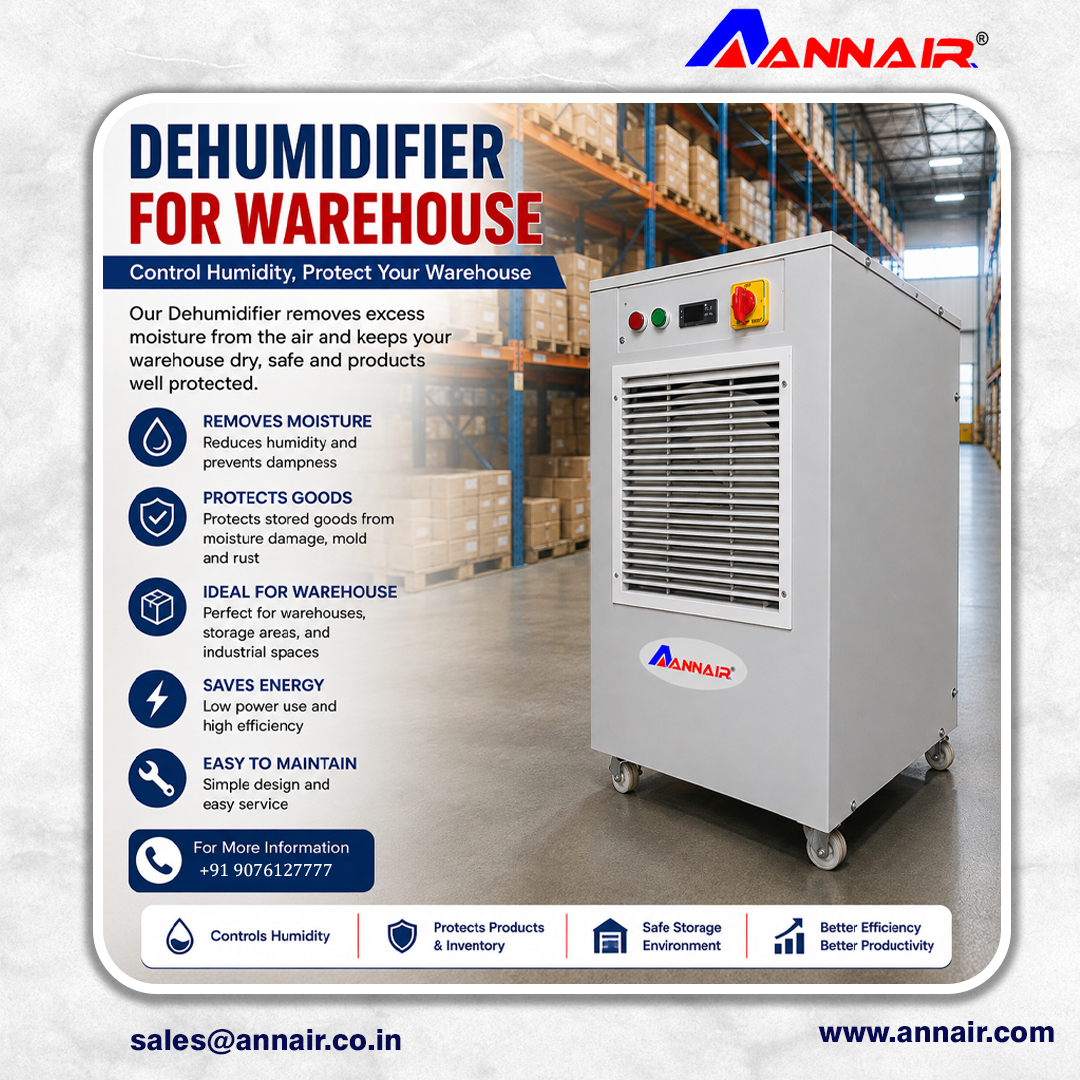
What to Look for in the Best Dehumidifier for Warehouse Use
A home dehumidifier will not survive a warehouse floor, and it definitely won't hold RH steady across a large open space. Industrial applications need a different spec sheet entirely.
Capacity That Matches Your Floor
Moisture removal capacity needs to be sized against your actual warehouse volume and the load coming in from doors and loading bays, not picked off a brochure. Undersized units run nonstop and still can't hold the target RH.
Performance in Real Ambient Conditions
A unit that performs well in a lab test at 25°C means little if your warehouse in Kochi sits at 33°C with 85% ambient RH for half the year. Ask how the equipment performs at conditions close to your actual site, not the ideal ones.
Built for Continuous Running
Warehouse units often run around the clock, sometimes for months without a break. That kind of duty cycle needs a build that can take it, not a unit designed for occasional home use.
Automatic Control and Drainage
A built-in humidistat and continuous drain cut down on manual checks, which matters when your staff can't be watching every zone of a large facility all day.
Quick takeaway: sizing mistakes cost more than the equipment itself. A dehumidifier for warehouse use should be matched to your actual floor area and moisture load, worked out properly, not estimated.
A Few Things That Help Beyond Just the Equipment
Sealing gaps around doors and loading bays keeps humid outside air from walking straight in every time a truck backs up. Insulating metal roofing reduces the day-night temperature swing that causes condensation in the first place. Position your dehumidifiers close to the actual problem zones, near loading docks, water-facing walls, low-airflow corners, rather than placing one unit in the middle of the floor and hoping it reaches everywhere.
Check RH at multiple points too, not just near the office where the reading usually looks fine. And plan for monsoon specifically. Facilities that prepare for the seasonal spike ahead of time consistently report less stock loss than the ones scrambling once the rains hit.
Frequently Asked Questions
What's the ideal humidity level for a general storage warehouse in India?
Most general storage warehouses aim for 45% to 55% relative humidity. Sensitive goods like electronics or pharma materials usually need a tighter, lower range based on the product's own storage requirement.
Can goods get damaged from humidity even without any visible leak?
Yes, and this catches a lot of people off guard. Airborne moisture alone is enough to cause corrosion, weaken packaging, and start mildew growth, even in a warehouse that looks completely dry.
How is a warehouse dehumidifier different from a home unit?
Industrial units are built for far higher moisture removal, continuous running, and larger open spaces. A home dehumidifier simply isn't designed to hold a stable RH across a full warehouse floor.
Does the target humidity level change with the season?
The target RH for your goods generally stays the same year-round. What changes is how much effort it takes to hold that level, especially during monsoon months in coastal regions where ambient humidity jumps sharply.
Where This Leaves You
Humidity isn't a one-time fix you install and forget. It's an ongoing part of running a warehouse in Indian conditions, and it needs the same attention as temperature or security. Know the right RH range for what you're storing, watch for the early signs before they become stock write-offs, and size your dehumidifier for warehouse operations against your actual space rather than a generic spec. For facilities handling sensitive goods or working out of high-humidity regions, getting this right early protects both your inventory and your equipment for years, not just one monsoon.
Need help sizing a dehumidifier for your warehouse?
Annair's engineering team can recommend the right capacity and setup based on your floor area and storage type.