
Common Problems Caused by Overheating in Electrical Control Panels
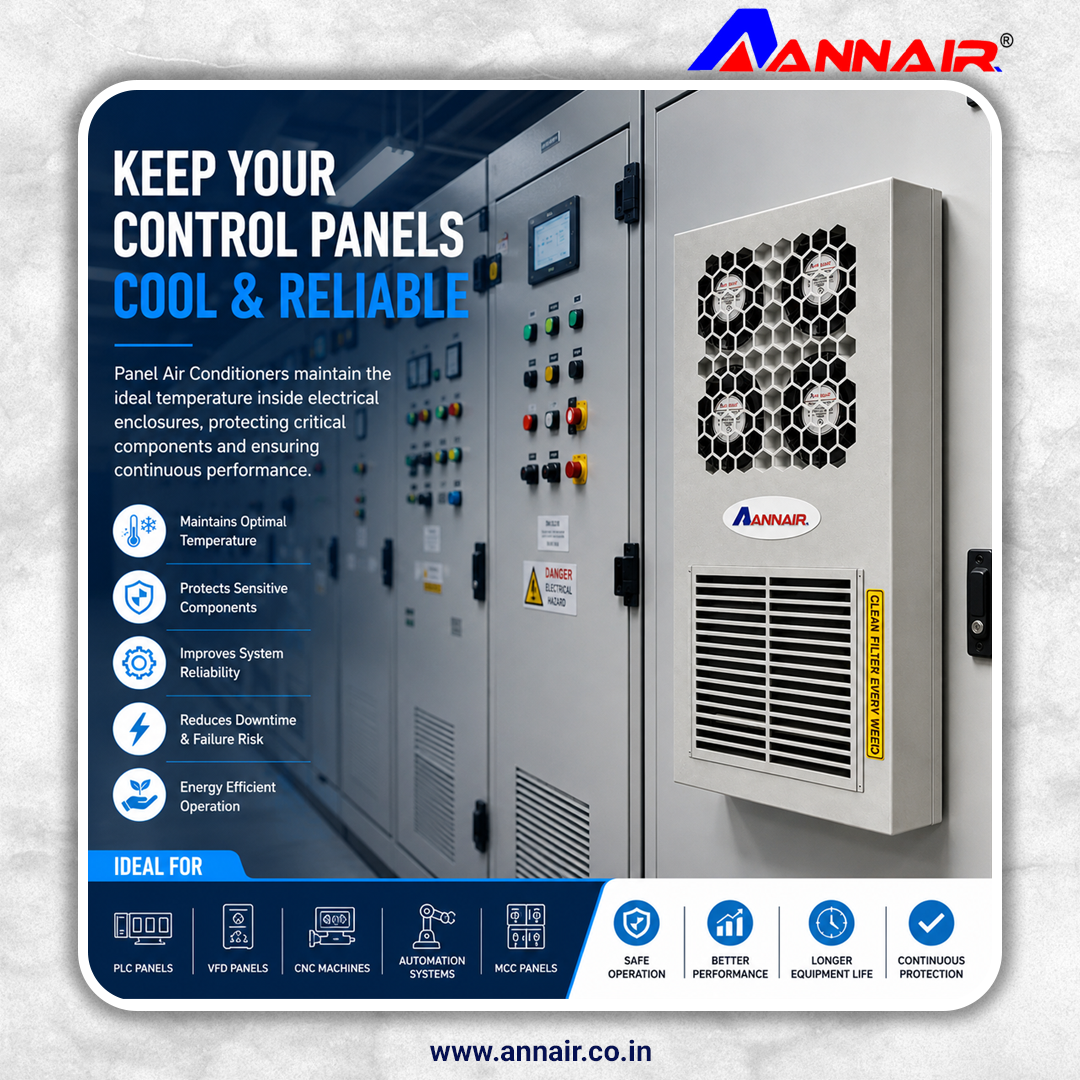
Electrical control panels are the heart and soul of any modern industrial facility. They are the central part of any control system, responsible for housing and protecting all of the critical machinery, such as PLCs, VFDs, contactors, relays, and circuit breakers. However, the very same equipment that makes the facility run can be a silent saboteur that causes serious issues and expensive downtime.
The primary reason why control panels become a point of failure is overheating. Due to the nature of their operation, many electrical devices and components produce a significant amount of heat. If the temperature inside the enclosure rises too high, serious problems can occur. Below are the most common issues that can happen in an overheated electrical control panel.
1. Nuisance Tripping and Unplanned Downtime
Thermal-magnetic circuit breakers and overload relays use heat from current flow through a bi-metallic strip as an indicator of overcurrent.
Problem: As ambient temperatures within enclosed cabinets rise above the normal ratings (typically 40C / 104F), breakers begin to "de-rate".
Result: Breakers and relays are tripping at less than full rated current, causing nuisance trips and unplanned downtime.
2. Premature Component Failure
High temperatures cause components to degrade much faster than normal. In general, for every 10C (18F) increase in temperature above the maximum operating temperature for a given component the life expectancy will be cut in half due to accelerated stress on the material. This is known as The 10C Rule also Arrhenius’ Law.
VFDs & Inverters: High temperatures shorten the life of the power capacitors because of the electrolytic content. This results in sporadic fault codes on the drives and ultimately complete drive failure.
PLCs & I/O: The microcontroller inside many components, including PLCs and I/O modules, can be damaged or cause erratic operation which results in expensive downtime for hardware replacement and lost profit due to reconfiguration of systems.
3. Insulation drying and loss of its function causing short-circuits
The insulation of wires, insulation of terminals, and the insulation of relay housing are made from polymers that resist the action of temperature during normal operation of the electrical equipment.
The damage mechanism: prolonged exposure to abnormal temperatures lead to insulation drying, hardening, and cracking
Consequence: the appearance of short circuits in the winding, inter-phase short circuits, and short circuits to ground.
4. Calibration Drift and Signal Errors
Precision control systems rely upon stable analog signals from sensors, transmitters, and signal conditioners (4-20 mA or 0-10V) to maintain process control and product quality.
The Problem: Copper wirings and electronics have resistance that varies with temperature
The Result: Calibration drifts of sensitive analog circuitry occurs when processes run too hot, causing poor control and poor quality.
5. Contact Welding and Mechanical Failure
Electromechanical components like contactors, relays, and switches generate mechanical arcs when opening and closing under load.
The Problem: High ambient cabinet temperatures prevent contact points from dissipating heat generated by normal switching arcs.
The Result: Contacts can soften and fuse together ("contact welding"), preventing the circuit from opening when required—creating a serious safety hazard.
📞 Contact Us
Our team is here to assist you with product details, quotations, or technical support.
📞 Phone: +91-9076127777
📧 Email: sales@annair.co.in
🌐 Website: www.annair.co.in