
How to Select an Air Dryer Based on Compressor Capacity
By Annair Drychill Tech India Pvt. Ltd. | Compressed Air Treatment Specialists, Ambernath, Maharashtra
If you have ever picked an air dryer using the horsepower rating printed on your compressor's nameplate, you have probably already run into the problem this article solves. Horsepower tells you almost nothing about the actual volume of air your compressor delivers. And if the dryer you install can't keep up with that volume, you end up with wet compressed air moving through your entire system, no matter how expensive the dryer was.
This guide walks through the exact method OEMs, panel builders, and plant engineers use to match an air dryer to compressor capacity so you avoid corrosion, pneumatic tool failure, and product contamination downstream.
Why Compressor Capacity Is the Starting Point for Dryer Selection
Every compressed air dryer has a rated drying capacity, expressed in CFM (cubic feet per minute) or m³/min. This number tells you the maximum volume of compressed air the dryer can treat while still hitting its rated pressure dew point. If your compressor pushes more air than the dryer is rated for, moisture starts passing through untreated. If the dryer is oversized for the compressor, you have paid for capacity you will never use, and you are running higher energy costs for no benefit.
Getting this match right starts with one number: your compressor's actual air delivery, not its motor size.
Step 1: Find Your Compressor's Free Air Delivery (FAD), Not Its Horsepower
Free air delivery is the actual volume of air your compressor produces at atmospheric conditions, converted to the working pressure of your system. It is listed on the compressor's data plate or datasheet, usually in CFM or m³/min. Two compressors with identical motor horsepower can have noticeably different FAD figures depending on their design and efficiency, so this is the only number worth trusting when you size a dryer.
As a rough field reference, screw compressors typically deliver somewhere in the range of 4 to 5 CFM per horsepower, though this varies by manufacturer and compressor design. Use it to sanity-check a datasheet, not to replace one.
Step 2: Record Your Actual Operating Conditions
Dryer capacity ratings are published under standard reference conditions, commonly 100°F (38°C) inlet air temperature, 100°F ambient temperature, and 100 psig line pressure. Your plant floor rarely matches all three. You need to note:
- Inlet air temperature—the temperature of compressed air entering the dryer, after the aftercooler
- Ambient temperature—the surrounding air temperature where the dryer sits, which matters most for refrigerated dryers rejecting heat
- Working line pressure—the actual system pressure, since a dryer's drying capacity drops as pressure falls below its rated point
In hot Indian and UAE plant environments, ambient temperatures well above 40°C are common, and this alone can reduce a refrigerated dryer's effective capacity well below its catalogue rating.
Step 3: Apply Correction Factors
Manufacturers publish correction factor tables that adjust a dryer's rated capacity for conditions that differ from the standard "100-100-100" reference. Every degree the inlet air runs hotter than 100°F increases the moisture load the dryer has to remove, and every degree the ambient runs hotter reduces how efficiently a refrigerated dryer can reject heat. Working pressure below the rated 100 psig also reduces effective drying capacity, since lower pressure means the air holds relative humidity differently at the same dew point target.
Practically, this means a dryer catalogued at 500 CFM might only deliver a genuine 350–400 CFM of reliable drying capacity once you correct for a 45°C ambient and a 40°C compressor discharge temperature. Skipping this step is the single most common reason dryers underperform in the field.
Quick takeaway: Always size against corrected capacity, not the number printed in the catalogue. A dryer that looks adequate on paper can fall short once real temperature and pressure conditions are applied.
Step 4: Choose a Dryer With Capacity Above Your Corrected FAD, Plus a Safety Margin
Once you have your corrected capacity requirement, select a dryer whose corrected output exceeds it. Most engineers build in a 10 to 15% safety margin to absorb peak demand spikes, seasonal ambient swings, and any planned expansion of compressed air load. This is not over-engineering; it is what keeps a system stable when a second shift starts up or a new line gets added six months later.
Step 5: Confirm the Dryer Meets Your Required Pressure Dew Point at That Capacity
Capacity and dew point are linked. A dryer can be sized correctly for flow and still fail to hit the pressure dew point your application needs if that dew point requirement is stricter than what the dryer technology can deliver. This is where the choice between refrigerated and heatless desiccant technology matters.
Refrigerated Air Dryers vs. Heatless Desiccant Dryers: Which Matches Your Compressor?
Both technologies are sized against compressor FAD the same way, but they serve different dew point and application needs:
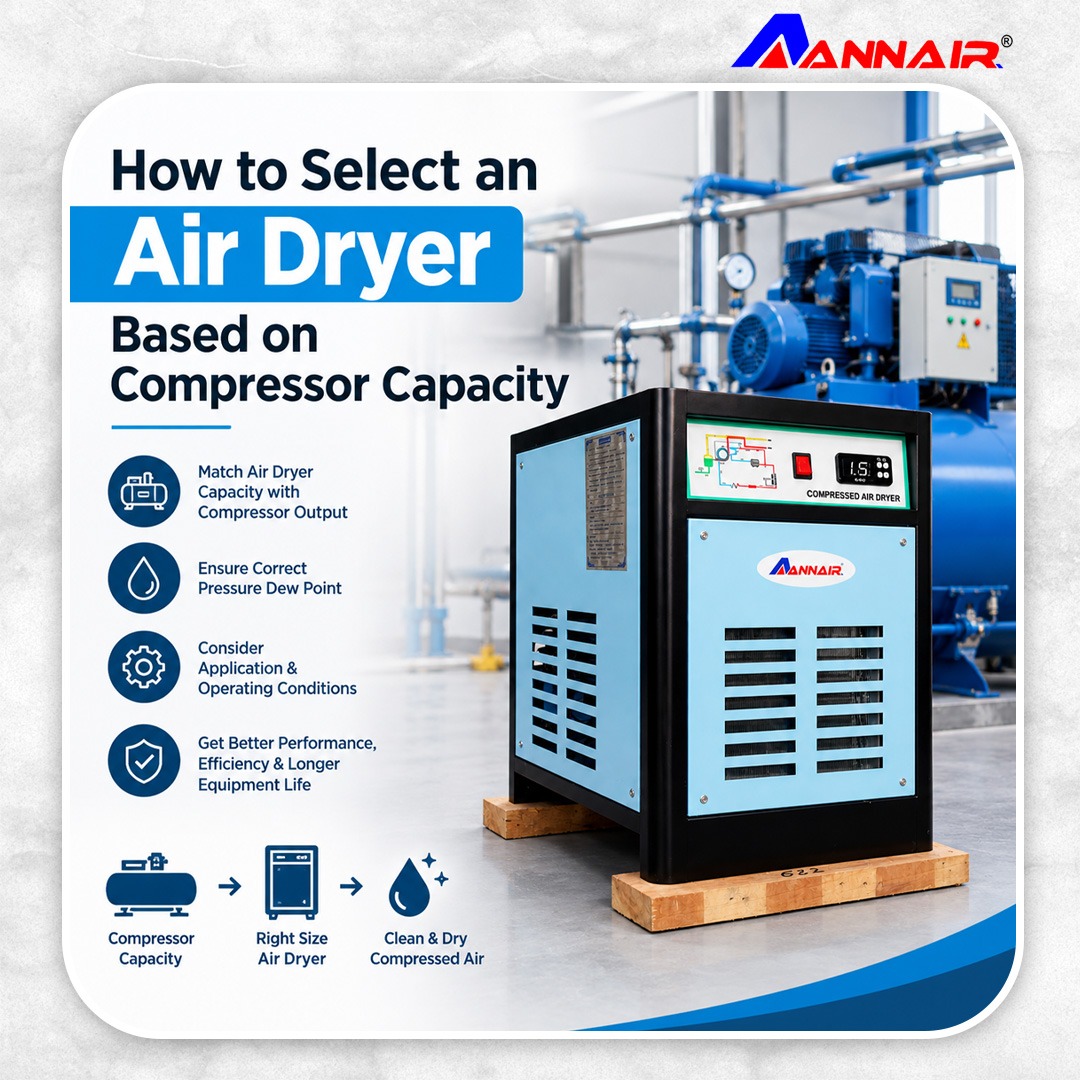
- Refrigerated air dryers typically deliver a pressure dew point around 3°C to 10°C. They suit general workshop air, pneumatic tools, and most manufacturing lines where moderate dryness is enough, and they run at a lower operating cost per CFM than desiccant systems.
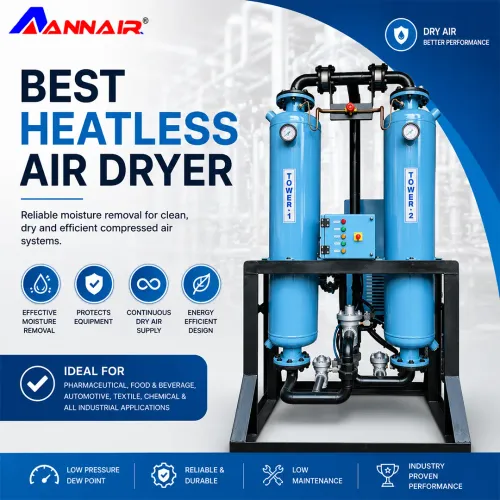
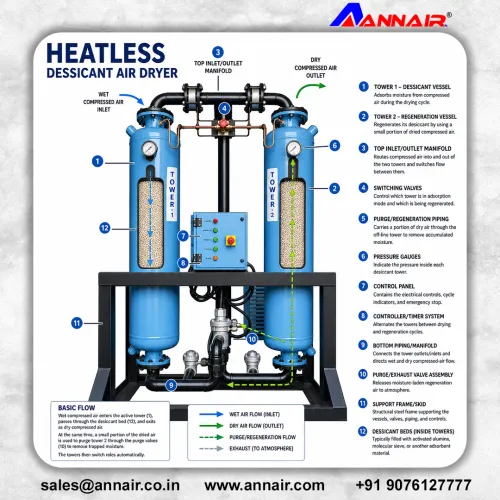
- Heatless desiccant air dryers deliver dew points down to -40°C, which is necessary for cold outdoor piping, pharmaceutical and food-grade air, instrumentation air, and any process where trace moisture can't be tolerated. They cost more to run because a portion of dried air is used to regenerate the desiccant bed, but they are the only realistic choice when your dew point requirement is severe.
If your compressor feeds a mixed load, general shop air plus one sensitive process line, many OEMs in India and the UAE size a refrigerated dryer for the bulk system and add a smaller point-of-use heatless desiccant dryer just ahead of the sensitive equipment, rather than treating the entire compressor output to the strictest standard.
Common Sizing Mistakes to Avoid
- Sizing off motor horsepower instead of FAD. Two compressors of the same HP can have meaningfully different actual air output.
- Ignoring ambient temperature. A dryer that performs well in a 25°C test lab can fall well short of its rating on a 45°C shop floor.
- Sizing for today's compressor, not tomorrow's load. Adding a second compressor or a new production line without revisiting dryer capacity is one of the most frequent causes of moisture complaints months after installation.
- Treating all compressed air to the strictest dew point. Running the entire plant's air through desiccant drying when only one process line needs it wastes energy across every other application.
How Annair Matches Dryers to Compressor Capacity
Annair Drychill Tech manufactures both refrigerated air dryers and heatless desiccant air dryers across a range of capacities, built to handle the ambient conditions typical of Indian and UAE industrial belts rather than dryers rated only under laboratory reference conditions. When OEM buyers, compressor manufacturers, and system integrators bring us a compressor spec sheet, we work back from actual FAD and site conditions to recommend a corrected capacity, not a catalogue number.
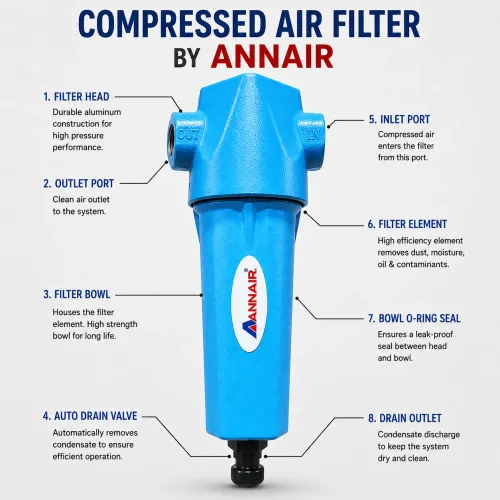
We also supply the surrounding equipment that keeps a dried air system performing as sized: compressed air filters to protect the dryer's desiccant bed and downstream equipment, automatic drain valves to clear condensate before it reaches the dryer, and water chillers and panel air conditioners for facilities that need tighter environmental control around sensitive process equipment.
Not sure which dryer capacity matches your compressor? Send us your compressor's spec sheet and site conditions, and we'll recommend the right corrected capacity.
Talk to Annair on WhatsAppFrequently Asked Questions
1. Can I just match dryer CFM to compressor CFM without correction factors?
You can, but the dryer will likely underperform in real conditions. Catalogue CFM ratings assume standard reference temperature and pressure. Applying correction factors for your actual ambient temperature, inlet air temperature, and working pressure gives you the true capacity you need.
2. What happens if I install a dryer that's too small for my compressor?
Air passes through faster than the dryer can treat it, so the pressure dew point rises above spec. Moisture reaches downstream piping and equipment, leading to corrosion, water in pneumatic tools, and contamination risk in sensitive processes.
3. Is it better to oversize a dryer for future expansion?
A modest 10-15% safety margin is standard practice. Beyond that, oversizing increases both capital cost and, for cycling refrigerated dryers, running cost, without a proportional benefit. It's better to size close to your corrected requirement with a reasonable margin than to buy significantly more capacity than you need today.
4. Do I need a heatless desiccant dryer, or will a refrigerated dryer work?
It depends on your required pressure dew point. Refrigerated dryers suit general compressed air use down to around 3-10°C dew point. If your application needs sub-zero dew points, outdoor piping in cold conditions, or moisture-sensitive processes like pharmaceuticals or electronics, a heatless desiccant dryer is the right choice.
5. How does high ambient temperature in Indian and UAE plants affect dryer sizing?
Refrigerated dryers reject heat to the surrounding air, so high ambient temperatures reduce their effective drying capacity below the catalogue rating. In regions where shop floor temperatures regularly exceed 40°C, this correction can be significant and should never be skipped during sizing.
6. Can one dryer serve multiple compressors?
Yes, as long as the dryer's corrected capacity covers the combined FAD of all compressors feeding it, including any that may run simultaneously during peak load. Size against the combined worst-case flow, not the average.