What Happens When You Run a Compressor Without an Air Dryer?
ANNAIR DRYCHILL TECH INDIA PVT. LTD. | COMPRESSED AIR SYSTEM CARE
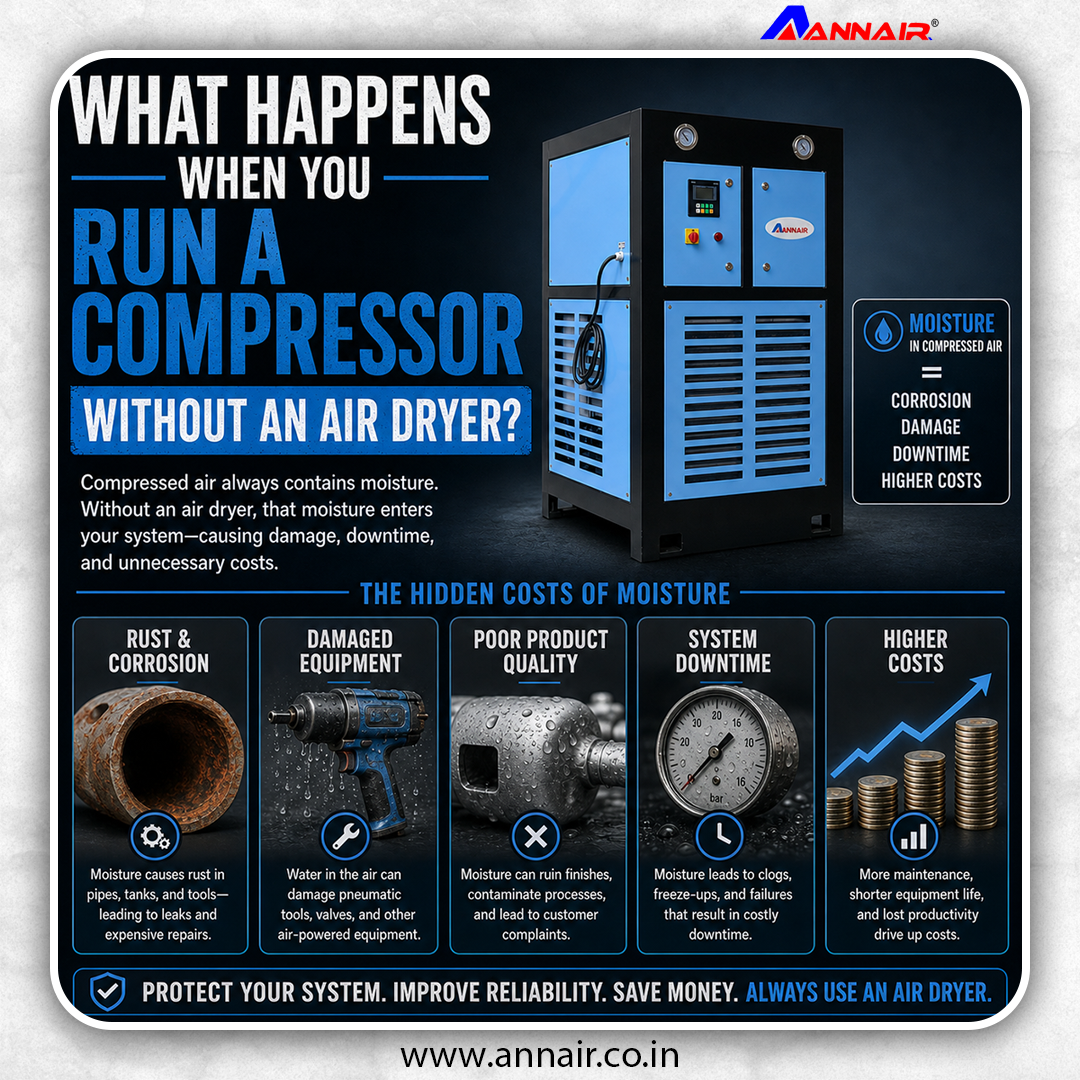
Walk into any compressor room that skipped an air dryer and you can smell it before you see it. Damp air, a faint metallic tang, sometimes a puddle near the pipe joints. Compressed air always carries moisture pulled in from the atmosphere, and if nothing removes it, that water travels straight into your pipelines, tools, and machines. Plenty of plants run this way for months without a problem, until the day a pneumatic valve sticks, a paint job comes out streaked, or a control panel trips for no obvious reason. By then the moisture has already done its work.
This piece looks at what actually happens inside your system when an air dryer is missing, why the damage builds up quietly, and where a properly sized dryer earns back its cost many times over.
Why Compressed Air Always Carries Water
Air itself holds water vapour, and the amount it can hold depends on temperature. A compressor pulls in ambient air and squeezes it, often to 7 or 8 bar. That compression raises the temperature sharply and packs far more water molecules into a smaller volume than the air can naturally hold once it cools back down. The result is condensation, and it happens inside your own piping, not just at the intake.
For every 27 cubic metres of free air a compressor draws in, roughly a litre of water can condense out as that air cools downstream. Multiply that across a full shift and a mid-sized industrial compressor and the numbers add up fast. None of that water disappears on its own. It sits in your receiver tank, travels through your distribution lines, and lands wherever the air slows down or cools further, which is usually right at your equipment.
Quick takeaway: Compressed air isn't dry by default. Compression concentrates moisture instead of removing it, so without a dryer, that water has nowhere to go but into your pipes and machines.
The Real Damage: What Skipping an Air Dryer Costs You
None of these problems show up on day one. That's what makes them dangerous. They build up over weeks and months, and by the time someone notices, the repair bill is already bigger than a dryer would have cost.
1. Internal Rust and Pipe Corrosion
Moisture sitting inside carbon steel piping starts corrosion almost immediately. Rust flakes break loose and travel downstream with the airflow, landing inside valves, cylinders, and filters. Over a year or two, this can mean replacing entire pipe runs that should have lasted a decade.
2. Pneumatic Component Failure
Solenoid valves, cylinders, and actuators are built with tight tolerances. Water washes away lubrication inside these parts, leading to sticking valves, slow cylinder response, and seals that wear out well before their rated life. A single stuck valve on a production line can halt output for hours.
3. Ruined Product Quality
In paint spraying, powder coating, and food packaging lines, compressed air touches the product directly. Moisture in that air shows up as fisheyes in paint finishes, clumping in powders, or contamination in packaged goods. Rework and rejected batches often cost more in a single quarter than a dryer would cost outright.
4. Freeze-Ups in Cold Environments
Where pipelines run outdoors or through unheated areas, trapped moisture can freeze in winter, blocking airflow completely or cracking fittings as ice expands. Facilities in northern India and hill regions see this every cold season without a dryer in place.
5. Shortened Equipment Life and Higher Downtime
Every part downstream of the compressor ages faster when it's fighting moisture. Filters clog sooner, drains fail, and unplanned stoppages become routine rather than rare. The maintenance team spends more time firefighting and less time on planned upkeep.
What an Air Dryer Actually Does
An air dryer sits between the compressor and the distribution network, and its only job is to pull moisture out of the airstream before it reaches your pipes and equipment. There are two main types, and each suits different applications.
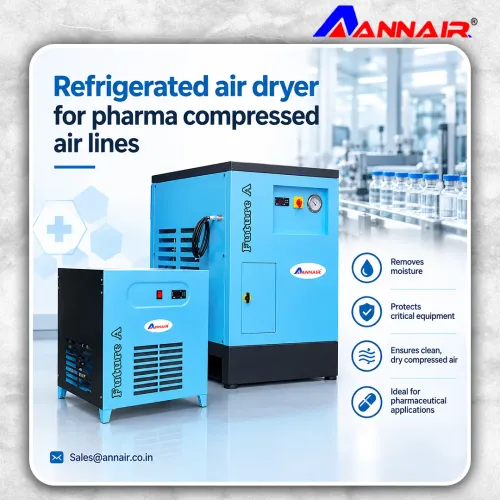
A refrigerated air dryer cools the compressed air to around 3°C, condenses the moisture out, and drains it away, then reheats the air slightly before it leaves the unit. This works well for general industrial use where a dew point around 3°C is acceptable, which covers most manufacturing, automotive, and general workshop applications.
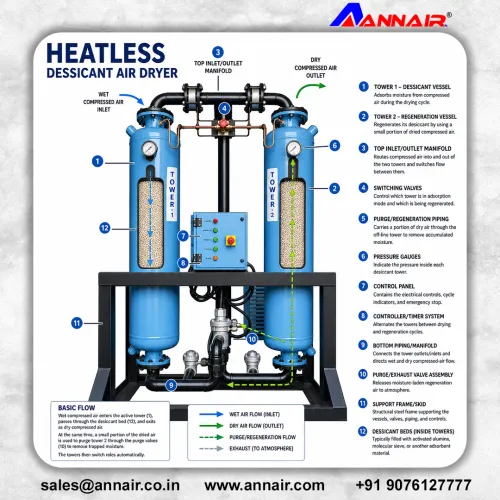
A heatless desiccant air dryer uses a bed of moisture-absorbing material to pull water vapour out chemically, reaching much lower dew points, often -40°C or below. This is the right choice for pharmaceutical plants, instrumentation air, outdoor pipelines in cold climates, and any process where even trace moisture is unacceptable.
Quick takeaway: Choosing between a refrigerated and a desiccant dryer comes down to the dew point your process actually needs. Most general manufacturing is fine with refrigerated; critical or outdoor applications need desiccant.
Where Air Dryers Are Used, and What You Gain
Air dryers aren't a niche add-on. They're standard equipment across almost every industry that runs a compressor, because dry air protects whatever comes after it.
| Application | Benefit of Dry Air |
| Automotive & OEM assembly | Longer life for pneumatic tools and robotic actuators |
| Paint & powder coating | No fisheyes, blistering, or clumped powder |
| Pharmaceutical & food processing | Meets hygiene and contamination-control standards |
| Instrumentation & control systems | Prevents sensor drift and valve sticking |
| Textile & packaging lines | Consistent product quality, fewer rejects |
Still running your compressor without a dryer? Every day without one adds to the wear your system is already carrying.
Talk to Annair on WhatsAppFrequently Asked Questions
Can I run a compressor for a short time without a dryer?
Technically yes, and many facilities do this during testing or emergencies. But moisture starts building up from the very first cycle, so short-term use without a dryer should never become a routine habit. Even a few weeks of continuous operation without one can leave rust deposits inside new piping.
Will a filter alone remove enough moisture instead of a dryer?
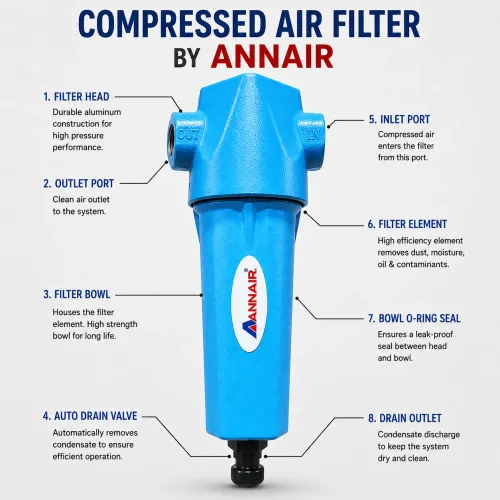
No. Filters remove particulates, oil aerosols, and some bulk liquid, but they don't lower the dew point of the air. Moisture vapour still passes through a filter and condenses further downstream. Filters and dryers do different jobs and are meant to work together, not replace each other.
How do I know which size air dryer my compressor needs?
Dryer sizing is based on your compressor's free air delivery (FAD), the inlet air temperature, ambient temperature, and working pressure. An undersized dryer won't hit the dew point you need, and an oversized one wastes energy and cost. Annair's team sizes dryers against your actual compressor specs rather than a generic chart.
What's the difference in running cost between refrigerated and desiccant dryers?
Refrigerated dryers generally cost less to run since they only need power for the refrigeration circuit. Heatless desiccant dryers consume a portion of your compressed air itself for regeneration, which adds to operating cost, but they deliver a much lower dew point where the process demands it.
Can moisture damage happen even with a good compressor brand?
Yes. The compressor's job is to generate compressed air, not to dry it. Moisture generation is a byproduct of compression itself, regardless of the compressor's build quality or brand. Drying is a separate function that has to be added downstream.
Getting It Right the First Time
Compressed air systems are meant to run for years without drama. An air dryer is the one component that decides whether that's actually true for your plant. Skip it, and you're not saving money, you're deferring a bigger repair bill to a date you don't control. Add the right dryer, sized correctly for your compressor, and the whole downstream system, from valves to finished product, runs the way it was supposed to.
Annair Drychill Tech India Pvt. Ltd. manufactures refrigerated air dryers, heatless desiccant dryers, water chillers, and compressed air filters for OEM buyers, system integrators, and industrial end users across India and the UAE. If you're not sure which dryer fits your compressor, our team can walk through the numbers with you.
Get the right air dryer sized for your compressor.
WhatsApp Annair NowAnnair Drychill Tech India Pvt. Ltd. | MIDC Ambernath, Maharashtra | annair.co.in