
What Is an Industrial Dehumidifier, and How Does It Work?
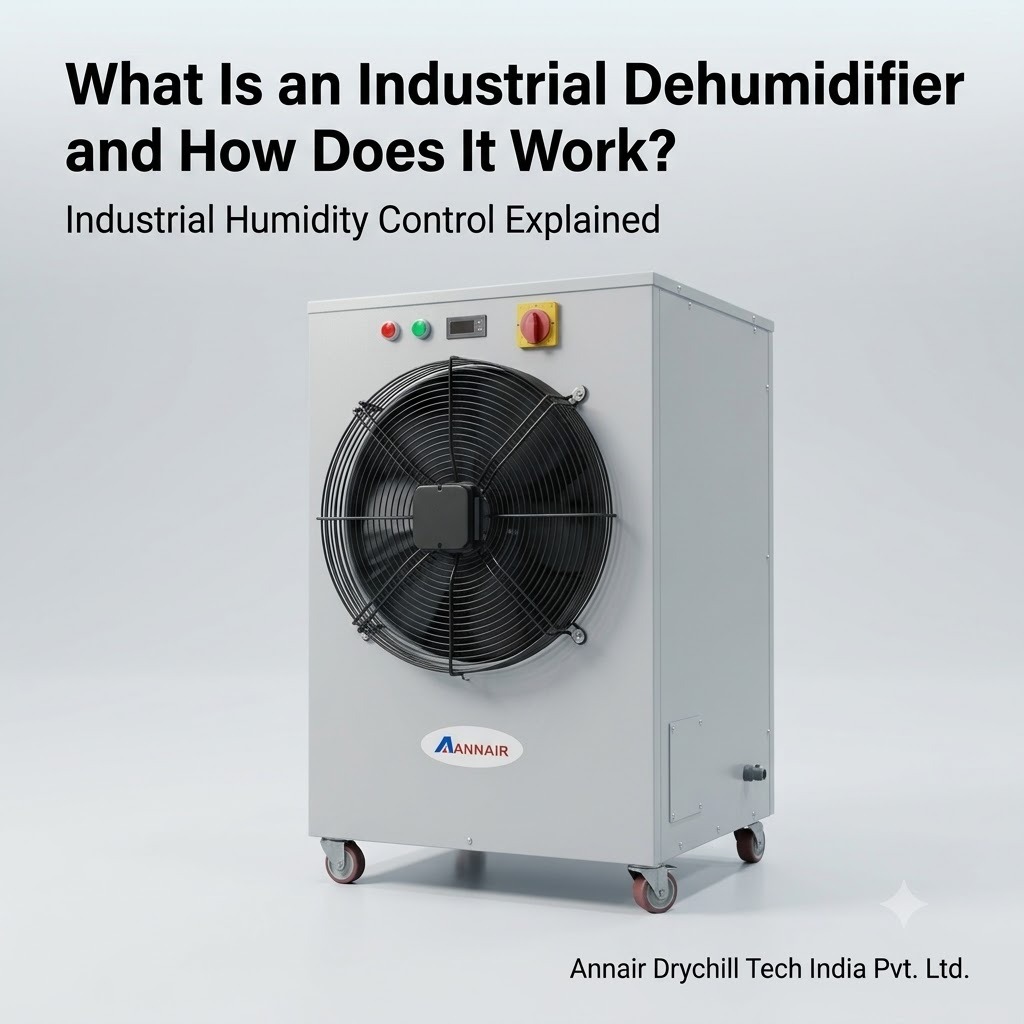
What is an industrial dehumidifier, and how does it work? An industrial dehumidifier is a high-capacity moisture-control system designed to remove excess humidity from large industrial spaces, manufacturing areas, warehouses, production rooms, and specialized processes. It works by drawing humid air into the unit, removing moisture through cooling or desiccant technology, and returning drier air to the environment. For OEMs and manufacturers in India and the UAE, industrial dehumidifiers can help protect products, machinery, raw materials, and production processes from moisture-related problems.
What Is an Industrial Dehumidifier, and How Does It Work?
An industrial dehumidifier is engineered to control relative humidity in environments where standard residential or commercial dehumidifiers are not sufficient.
The basic operating principle is straightforward:
- Humid air enters the dehumidifier through an intake system.
- The air passes through a moisture-removal section.
- Water vapor is separated from the air using either refrigeration-based cooling or desiccant technology.
- The collected moisture is drained or discharged through the appropriate system.
- Drier air is returned to the industrial environment.
By continuously controlling humidity, an industrial dehumidification system can create a more stable environment for manufacturing, storage, processing, and other industrial applications.
How Does an Industrial Dehumidifier Work?
Industrial dehumidifiers generally use one of two major moisture-removal technologies: refrigerant-based dehumidification and desiccant dehumidification.
1. Refrigeration-Based Dehumidification
A refrigeration dehumidifier cools humid air below its dew point. As the air temperature falls, water vapor condenses into liquid water.
The basic process is
Humid air → Cooling coil → Condensation → Water removal → Drier air
This type of system can be effective in many industrial environments where moderate-to-high humidity needs to be controlled.
2. Desiccant Dehumidification
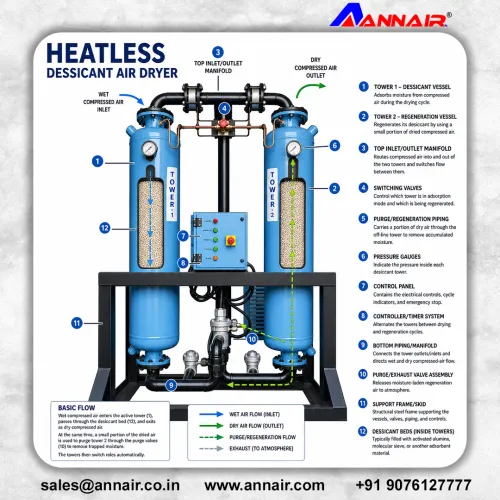
A desiccant dehumidifier uses a moisture-absorbing material to remove water vapor from the air.
Desiccant systems are particularly useful when very low humidity levels are required or when the application involves challenging temperature conditions.
The process can be summarized as
Humid air → Desiccant material → Moisture absorption → Dry air
The appropriate technology depends on factors such as the required humidity level, temperature, airflow, room volume, process requirements, and operating conditions.
Why Is Industrial Humidity Control Important for Manufacturers?
Excess humidity can create significant challenges for manufacturing and storage operations.
High moisture levels may contribute to:
- Corrosion of metal components and machinery
- Condensation on equipment and surfaces
- Mold and fungal growth
- Product deterioration
- Packaging problems
- Moisture absorption by raw materials
- Reduced shelf life
- Production interruptions
- Electrical and electronic component issues
- Unstable manufacturing conditions
For manufacturers, humidity control is therefore not simply about comfort. It can be an important part of process control, product protection, equipment reliability, and quality management.
Uses of Industrial Dehumidifiers
Industrial dehumidifiers are used across a wide range of manufacturing and commercial applications.
Manufacturing Plants
Humidity control can help maintain more consistent environmental conditions around production lines and sensitive manufacturing processes.
Warehouses and Storage Facilities
Moisture can damage stored materials, packaging, machinery, and finished goods. An industrial dehumidifier can help maintain appropriate storage conditions.
Pharmaceutical Manufacturing
Pharmaceutical products and ingredients can be sensitive to environmental moisture. Controlled humidity can support stable manufacturing and storage environments.
Food Processing and Storage
Humidity management can be important for certain food-processing and storage applications where excess moisture can affect product quality.
Electronics and Electrical Manufacturing
Electronic components and electrical equipment may be vulnerable to moisture and condensation. Dehumidification can help create a controlled production environment.
Automotive and Engineering Industries
Industrial dehumidification can help protect metal components and equipment from moisture-related corrosion, particularly in humid environments.
Cold Rooms and Specialized Storage
Humidity control can help address condensation and moisture-related issues in selected cold-storage and temperature-controlled applications.
Packaging and Material Processing
Some materials can absorb moisture from the surrounding air. Maintaining controlled humidity can improve consistency during processing and packaging.
Benefits of an Industrial Dehumidifier
Choosing the right industrial dehumidification system can provide several operational benefits.
1. Controls Excess Moisture
The primary purpose of an industrial dehumidifier is to reduce unwanted moisture and maintain a more stable relative humidity level.
2. Helps Reduce Corrosion
Lowering excess humidity can help reduce conditions that contribute to corrosion of metal components and industrial equipment.
3. Protects Products and Raw Materials
Moisture-sensitive products and materials can benefit from a controlled storage and production environment.
4. Supports Better Process Control
Stable environmental conditions can improve consistency for processes that are sensitive to humidity fluctuations.
5. Helps Reduce Condensation
Dehumidification can help manage condensation on surfaces and equipment when humidity is contributing to the problem.
6. Supports Equipment Protection
Controlling moisture around electrical, electronic, and mechanical equipment can help create a more suitable operating environment.
7. Can Improve Storage Conditions
For warehouses and industrial storage facilities, humidity control can help protect inventory and packaging from moisture-related damage.
Industrial Dehumidifier for India and UAE
India and the UAE include many industrial environments where humidity management can be an important consideration.
In India, manufacturers may need dehumidification solutions for humid production environments, warehouses, pharmaceutical facilities, food processing units, electronics manufacturing, engineering industries, and other applications.
In the UAE, high ambient temperatures combined with significant humidity in many locations can create challenging conditions for industrial facilities, storage areas, and manufacturing operations.
For OEMs and industrial manufacturers, the right system should be selected according to the actual application rather than simply choosing a unit based on room size.
How to Select the Right Industrial Dehumidifier
Before selecting an industrial dehumidifier, manufacturers should evaluate several technical parameters:
- Required humidity level
- Existing relative humidity
- Room dimensions and volume
- Airflow requirement
- Operating temperature
- Moisture load
- Number of doors and openings
- Heat generated by machinery
- Number of people in the area
- Product or material moisture sensitivity
- Continuous or intermittent operation
- Installation conditions
- Drainage requirements
- Energy-efficiency considerations
A professional assessment can help determine the appropriate dehumidifier capacity, airflow, technology, and configuration for the application.
Industrial Dehumidifier Manufacturer for OEM Applications
For OEMs and industrial manufacturers, equipment requirements can vary considerably from one application to another. A suitable dehumidification solution may need to be designed around specific airflow, humidity, temperature, installation, and process requirements.
Annair Drychill Tech India Pvt. Ltd. provides industrial HVAC and moisture-control solutions, including air dryers, water chillers, panel AC systems, and dehumidifiers, for industrial applications.
For OEM and manufacturing requirements in India and the UAE, businesses can evaluate the required operating conditions and select a dehumidification solution suited to their application.
Industrial Dehumidifier vs. Commercial Dehumidifier
The key difference is generally capacity, construction, operating conditions, and application requirements.
| Feature | Industrial Dehumidifier | Commercial Dehumidifier |
|---|---|---|
| Application | Manufacturing and industrial environments | Offices, commercial spaces, and smaller facilities |
| Capacity | Typically higher | Typically lower |
| Operating Conditions | Designed for demanding applications | Designed for lighter-duty environments |
| Customization | Often available for application requirements | Usually more standardized |
| Integration | Can be integrated into industrial HVAC/process systems | Often operates as a standalone unit |
The correct choice depends on the moisture load and application rather than the name of the facility alone.
Frequently Asked Questions About Industrial Dehumidifiers
What is an industrial dehumidifier used for?
Industrial dehumidifiers are used to control excess moisture in manufacturing plants, warehouses, storage facilities, pharmaceutical and food-processing environments, electronics facilities, engineering industries, and other applications requiring controlled humidity.
How does an industrial dehumidifier remove moisture?
Depending on the technology, it removes moisture either by cooling humid air until water condenses or by using a desiccant material that absorbs water vapor from the air.
Is an industrial dehumidifier suitable for a warehouse?
Yes. Industrial dehumidifiers can be used in warehouses where excess humidity may affect stored products, raw materials, packaging, machinery, or other inventory.
What humidity level should an industrial facility maintain?
There is no single ideal humidity level for every facility. The appropriate relative humidity depends on the product, manufacturing process, equipment, temperature, and industry requirements.
What is the difference between a desiccant and a refrigerant dehumidifier?
A refrigerant dehumidifier primarily removes moisture by cooling humid air and condensing water vapor. A desiccant dehumidifier uses a moisture-adsorbing material and can be advantageous for applications requiring low humidity or operation under specific temperature conditions.
How do I choose the capacity of an industrial dehumidifier?
Capacity depends on factors including room volume, temperature, existing relative humidity, target humidity, moisture load, airflow, openings, machinery, and process conditions. A technical assessment is recommended before selecting capacity.
Can industrial dehumidifiers be used in the UAE?
Yes. Industrial dehumidification can be used in UAE manufacturing, storage, and other facilities where environmental moisture needs to be controlled. Equipment selection should account for the local operating conditions and application requirements.
Can an industrial dehumidifier be customized for OEM applications?
Depending on the manufacturer and application, industrial dehumidification systems can be configured to meet specific airflow, capacity, installation, control, and process requirements. OEMs should discuss their technical specifications with the manufacturer.
Conclusion: What Is an Industrial Dehumidifier, and How Does It Work?
So, what is an industrial dehumidifier, and how does it work? It is an industrial moisture-control system that removes water vapor from air to help maintain the required humidity conditions. Depending on the application, it can use refrigeration or desiccant technology to reduce moisture and provide controlled, drier air.
For manufacturers and OEMs, industrial dehumidification can support product protection, process stability, corrosion control, equipment protection, and improved storage conditions. The right solution depends on the facility, moisture load, target humidity, temperature, airflow, and specific manufacturing requirements.
Annair Drychill Tech India Pvt. Ltd. offers industrial solutions, including dehumidifiers, air dryers, water chillers, and panel AC systems. Manufacturers and OEMs in India and the UAE can evaluate their application requirements to identify a suitable solution for effective humidity control.