
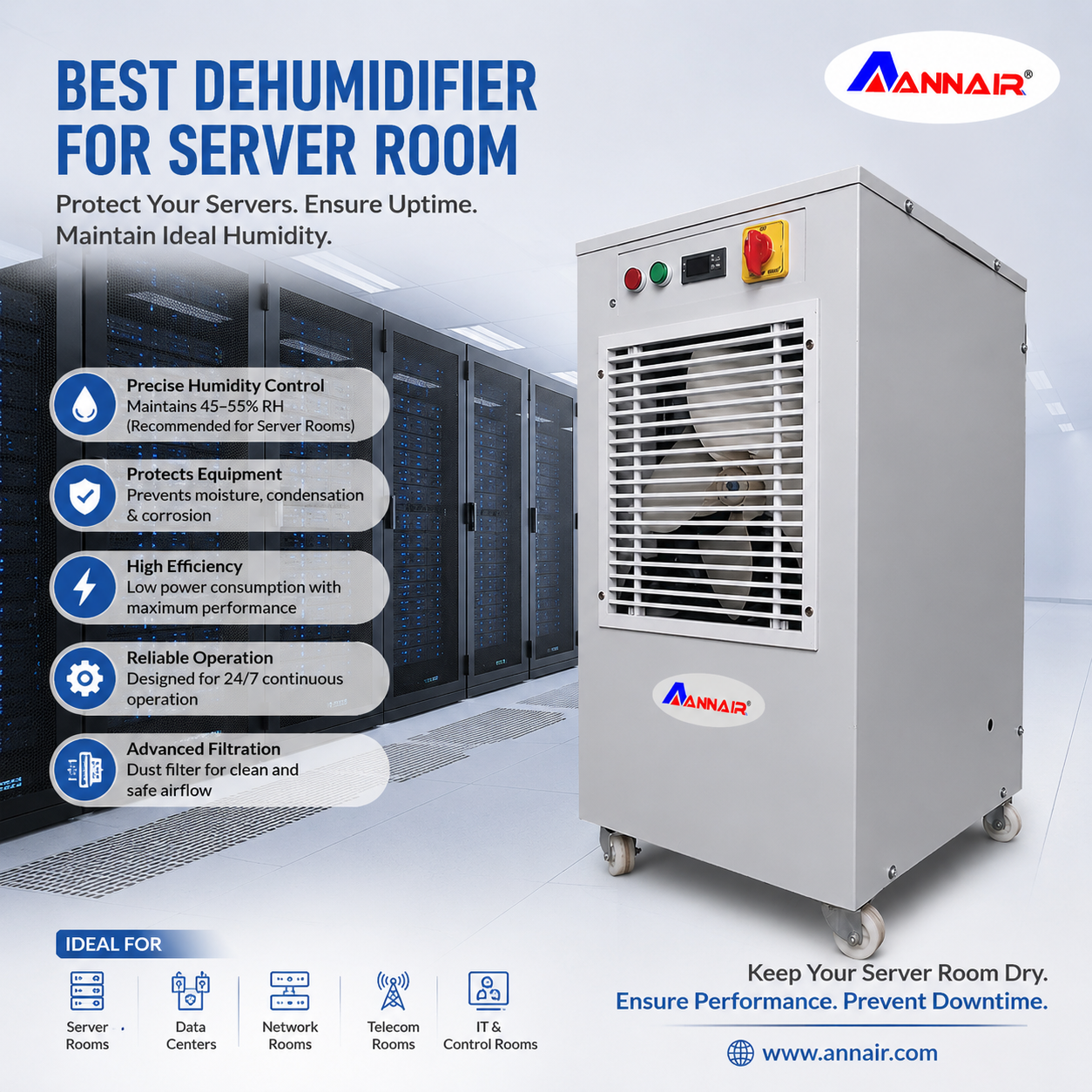
Best Dehumidifier for Server Room: Stop Condensation Before It Costs You a Rack
If you're hunting for the best dehumidifier for server room environments, here's what actually matters: precision. Not just pulling moisture out of the air, but holding humidity in a tight, stable band so condensation never gets a chance to form on your equipment. One humidity spike. That's all it takes to fry a rack, corrode a connector, or trigger an outage nobody saw coming.
We build industrial dehumidifiers for exactly this kind of high-stakes environment. Data centers. Server rooms. Food plants. Cold storage. Places where "close enough" on humidity control just isn't good enough.
Why Server Rooms Need a Different Kind of Dehumidifier
Here's the problem with generic humidity control. Most units are built to handle a room, roughly. Get it "dry enough." Server rooms don't work like that.
Too dry, and you get static buildup — a real risk to sensitive electronics. Too humid, and you get condensation on cool surfaces, which is basically an invitation for corrosion and short circuits. The window you're aiming for is narrow. And it has to stay narrow, 24/7, without drift.
That's precision humidity control. It's not a nice-to-have here. It's the whole job.
A few things that make server room humidity control genuinely different from a standard warehouse setup:
- Tight tolerance bands — small swings matter, unlike open storage areas
- Continuous monitoring and fast correction, not slow, reactive adjustment
- Low noise and compact footprint, since server rooms are already tight on space
- Zero tolerance for downtime — the equipment can't be the reason for an outage
Who We Build This For
This isn't a one-size-fits-all product line. We work across industries where humidity control is directly tied to product quality, equipment safety, or compliance:
- Data centers and server rooms — precision control to prevent condensation-driven equipment failure
- Manufacturing facilities — protecting machinery, tooling, and raw materials from moisture damage
- Warehouses and storage facilities — a good dehumidifier for warehouse spaces keeps stock dry through every season, not just the monsoon
- Food and beverage processing plants — where a dehumidifier for food industry use has to meet hygiene standards while controlling spoilage risk
- Pharmaceutical companies — stable humidity is often a compliance requirement, not just a comfort factor
- Cold storage and logistics businesses — managing condensation at the edges of temperature-controlled zones
If your team has ever had a "why did that fail" conversation that ended with humidity as the answer, you already know why this matters.
What Precision Humidity Control Actually Looks Like
Let's be honest. A lot of "dehumidifiers" on the market are built for general-purpose drying. Basements, garages, storage rooms. Fine for that. Not fine for a server room.
Precision control means the unit is constantly reading the room and adjusting, not just running until a rough target is hit and then shutting off. It's the difference between a thermostat that swings five degrees either way, and one that holds steady within a fraction of a degree.
Here's a quick side-by-side of what that difference looks like in practice:
| Feature | Standard Dehumidifier | Precision Server Room Dehumidifier |
|---|---|---|
| Humidity tolerance | Wide swings (+/- 10%) | Tight band (+/- 2-3%) |
| Response time | Slow, reactive | Fast, continuous correction |
| Noise level | Often loud | Low-noise for occupied/technical spaces |
| Build focus | General moisture removal | Condensation prevention + static control |
| Monitoring | Basic on/off | Continuous readout, alerts on drift |
| Best fit | Storage, warehouses | Server rooms, cleanrooms, sensitive equipment areas |
This is exactly the gap between a decent dehumidifier for warehouse floors and one you'd actually trust next to a rack of servers.
The Real Risk: Condensation on Critical Equipment
Condensation doesn't announce itself. It builds up quietly on cool surfaces — the back of a server chassis, a cold pipe, a metal panel near an AC vent. By the time you see water, you've probably already got corrosion starting somewhere you can't see.
For data centers, that's a direct line to hardware failure and downtime. For food and beverage plants, it's spoilage and failed hygiene checks. For pharma, it's compliance risk on top of product risk.
We've had clients reach out after a near-miss. A humidity sensor that flagged just in time. Or worse, after actual equipment loss. Either way, the fix is the same: control the humidity properly, before it controls your outcomes.
Sizing It Right: Capacity, Sensitivity, and Room Layout
Getting the capacity right matters everywhere. But in a server room, sensitivity matters just as much as raw capacity.
A few questions we always walk through with clients:
- What's the room size, and how much heat-generating equipment is packed in?
- What humidity range do you need to hold, and how tight does the tolerance need to be?
- Is there existing HVAC or cooling that the dehumidifier needs to work alongside?
- Any compliance requirements tied to humidity logging or reporting?
Get this wrong, and you either end up with a unit that can't keep up, or one that's oversized and cycling constantly — which is its own kind of stress on the equipment.
Built for Industrial Reliability, Not Just Home Comfort
We supply industrial dehumidifiers across India and into the UAE, where facilities deal with everything from high ambient heat to dense, moisture-heavy processing environments. Whether it's a server room needing tight tolerance control, a food plant needing steady hygiene-grade conditions, or a warehouse that just needs a reliable, good dehumidifier for industrial storage, the build quality is what separates a unit that lasts from one you're replacing next year.
We work directly with OEM buyers and industrial procurement teams who need equipment that performs the same way on day 1,000 as it did on day one.
Final Thoughts
If you're comparing options for the best dehumidifier for server room use, don't just look at capacity numbers on a spec sheet. Look at tolerance range, response time, and build quality for continuous operation. That's what actually protects your equipment.
Condensation is a quiet risk until it isn't. Don't wait for the near-miss.