
What Is a Heatless Air Dryer and How Does It Work?
If your plant runs on compressed air, moisture is probably costing you more than you think. Rusted valves. Failed sensors. Batches rejected because the air wasn't dry enough. It happens more often than most maintenance teams admit.
A heatless air dryer solves this without adding a single watt of a heating element to your system. It's one of the simplest, most reliable ways to get pharma-grade or ISO-compliant dry air—and it's been quietly doing the job in factories for decades. Let's break down what it actually is, how it works, and why it might be the missing piece in your compliance checklist.
Key Takeaways
- A heatless air dryer removes moisture from compressed air using two desiccant towers that alternate between drying and regenerating — no external heat needed.
- It can achieve dew points as low as -40°C to -70°C, exactly what pharma and precision manufacturing standards demand.
- Compared to refrigerant dryers, it delivers lower dew points, making it the go-to choice where ISO 8573-1 or GMP air quality is non-negotiable.
- Annair's heatless desiccant air dryers are engineered for consistently lower dew points, so you stay compliant without babysitting the system.
What Exactly Is a Heatless Desiccant Air Dryer?
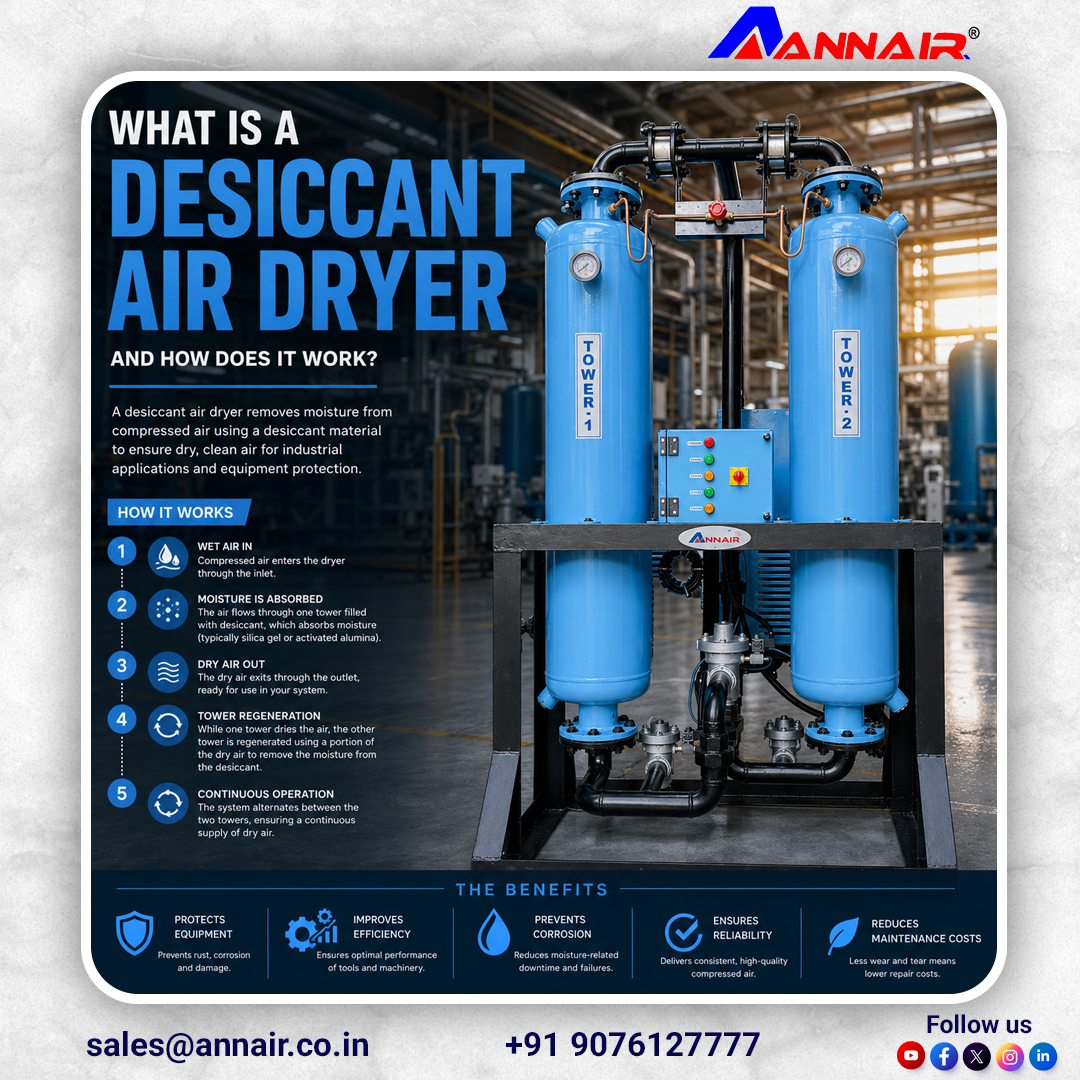
Think of it as a moisture trap with a twin-tank system. Compressed air enters one tower packed with desiccant beads—usually activated alumina or molecular sieve. These beads grab water vapor the way a sponge grabs water. Dry air exits, ready to use.
Meanwhile, the second tower is busy regenerating. A small portion of the already-dried air (roughly 15%) is diverted through it at low pressure. This purge air strips the moisture out of the desiccant bed and carries it out through an exhaust valve.
After a set cycle — typically 5 to 10 minutes — the towers switch roles. One dries, and the other regenerates. Back and forth, continuously. No heaters. No burners. Just pressure differential and clever engineering doing the work.
That's the "heatless" part. A heated desiccant dryer, by contrast, uses electric heaters or blowers to regenerate the desiccant, which lowers purge air loss but adds complexity and running cost. For many industrial applications, heatless simply makes more sense—fewer moving parts, less to go wrong.
Why Manufacturers Care About This (More Than They Used To)
Here's the real problem. Compressed air isn't just "air" once it's inside your plant. It touches your pneumatic actuators, your instrumentation, your packaging lines, and sometimes your product itself.
If you're in pharma, food processing, or precision electronics, that air has to meet a standard. ISO 8573-1. GMP guidelines. Client audit checklists. Miss the mark, and you're not just fixing equipment — you're explaining a failed audit to your quality team, or worse, a regulator.
We hear this constantly from plant engineers: "Our refrigerant dryer passes on paper, but the auditor flagged our dew point anyway." That's because refrigerant dryers typically bottom out around +3°C to +10°C dew point. Good enough for general industrial use. Not good enough when the spec calls for -40°C.
This is exactly where an industrial desiccant air dryer earns its place. It's not overkill — it's the only realistic way to hit those numbers reliably, day after day, without constant recalibration.
Heatless vs. Heated vs. Refrigerant Dryers — A Quick Comparison
| Feature | Heatless Desiccant Dryer | Heated Desiccant Dryer | Refrigerant Dryer |
|---|---|---|---|
| Typical Dew Point | -40°C to -70°C | -40°C to -70°C | +3°C to +10°C |
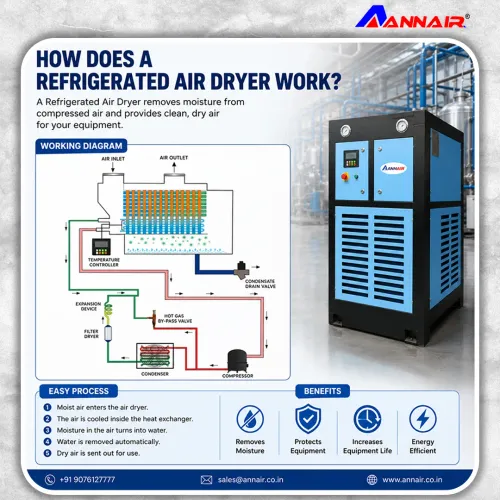
| Energy Source | Compressed air purge only | Electric heater + purge | Refrigeration compressor |
| Running Cost | Moderate (purge air loss) | Lower purge loss, higher power draw | Lowest overall cost |
| Maintenance Complexity | Low | Medium (heater elements) | Medium (refrigerant circuit) |
| Best Suited For | Pharma, labs, precision instruments | Large-volume plants, cost-sensitive ops | General workshops, tools, painting |
| Compliance Fit (ISO/GMP) | Excellent | Excellent | Limited |
If your air quality spec is strict, this table basically makes the decision for you.
Where This Actually Shows Up on the Shop Floor
You don't need to imagine hypothetical scenarios. This is what moisture in compressed air actually does:
- Corrodes valves and cylinders from the inside, shortening equipment life
- Contaminates pharmaceutical tablets or capsules during coating and packaging
- Causes false readings in pneumatic instrumentation and sensors
- Freezes in outdoor lines during winter, blocking air flow entirely
- Fails third-party audits, delaying product certification or shipment
None of these are rare edge cases. We've seen all of them, more than once, in plants that assumed their existing dryer was "good enough."
What Makes Annair's Heatless Air Dryer Different
Plenty of manufacturers sell a twin-tower dryer. Fewer of them engineer it to hold a genuinely low, stable dew point under real plant conditions — not just on a spec sheet.
That's the gap we built our systems around. Annair's heatless desiccant air dryers are designed to:
- Maintain consistently lower dew points even under fluctuating load
- Meet ISO 8573-1 and pharma-grade air purity requirements out of the box
- Run with minimal desiccant degradation over extended duty cycles
- Integrate directly into OEM machine skids without redesign headaches
If you're an OEM manufacturer building compressed air systems into your own equipment or a pharma plant trying to close a compliance gap before your next audit, this is the kind of detail that actually matters.
A Word on Sizing
One mistake we see often: buying a dryer sized only for current air demand, with zero headroom for expansion. Compressed air demand almost always grows. A dryer that's marginal today becomes a bottleneck in eighteen months.
We size every unit against your actual flow rate, inlet temperature, and pressure—not just a catalog number. Get this wrong, and even the best desiccant dryer in the world will underperform.
Frequently Asked Questions
How long does desiccant last in a heatless air dryer?
Under normal operating conditions, desiccant typically lasts 3 to 5 years before replacement is needed, depending on inlet air quality and cycle load.
Can a heatless dryer handle pharma-grade compliance on its own?
Yes, in most cases. Paired with proper pre-filtration and correct sizing, a heatless desiccant dryer comfortably meets ISO 8573-1 and GMP dew point requirements.
Is a heatless dryer more expensive to run than a refrigerant dryer?
It uses more purge air, which does add some operating cost. But for compliance-driven applications, that trade-off is usually non-negotiable anyway — refrigerant dryers simply can't hit the same dew point.
Final Thought
A heatless air dryer isn't a fancy add-on. It's often the one component standing between your plant and a failed compliance audit. If your current dryer is leaving you guessing on dew point, that's a risk worth closing now, not after an auditor points it out.
Contact Us
Need help or want to use our services? We're here to assist you.
📧 Email: sales@annair.co.in
📞 Phone: +91-9076127777
🌐 Website: www.annair.com
Ambernath