
Desiccant Air Dryer: Working Principle, Components & Applications
Learn how a desiccant air dryer works, its key components, and where heatless dryers are used across Mumbai, Thane, and UAE industrial plants. Practical buying guide inside. If you run compressed air equipment anywhere in Mumbai, Thane, or Bhiwandi, you already know what moisture does to a pneumatic line—rust inside pipework, sticky cylinders, and valves that jam without warning. A desiccant air dryer is one of the two standard ways to deal with this, and it's the one people reach for when the air genuinely needs to be dry, not just cooled down a bit.
This article covers what a desiccant air dryer is, how the heatless version works, what's actually inside one, and where it gets used across manufacturing units in Mumbai, Navi Mumbai, Bhiwandi, Dombivli, Ambernath, Kalyan, and Taloja.
What Is a Desiccant Air Dryer?
A desiccant air dryer removes water vapor from compressed air by passing it through a bed of hygroscopic material, usually activated alumina or a molecular sieve. Unlike a refrigerated dryer, which cools the air stream to condense moisture out, a desiccant dryer pulls the moisture out through adsorption—the water vapor sticks to the surface of the desiccant beads as air passes through. That's the reason desiccant dryers can achieve dew points of -40°C and lower, a level refrigerated units aren't built to reach.
What Is a Desiccant Air Dryer System?
A desiccant air dryer system is the complete setup built around the dryer, not just the dryer vessel itself. It typically includes a pre-filter, the twin-tower dryer, an after-filter, and sometimes a dew point monitor or controller. A tower full of desiccant beads on its own won't do much good in a factory environment—it's the filtration ahead of it that keeps oil and dust from fouling the bed and the filtration after it that catches any desiccant fines carried downstream.
How a Heatless Desiccant Air Dryer Works
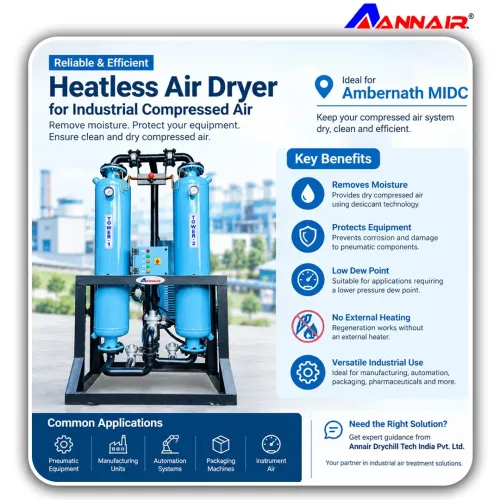
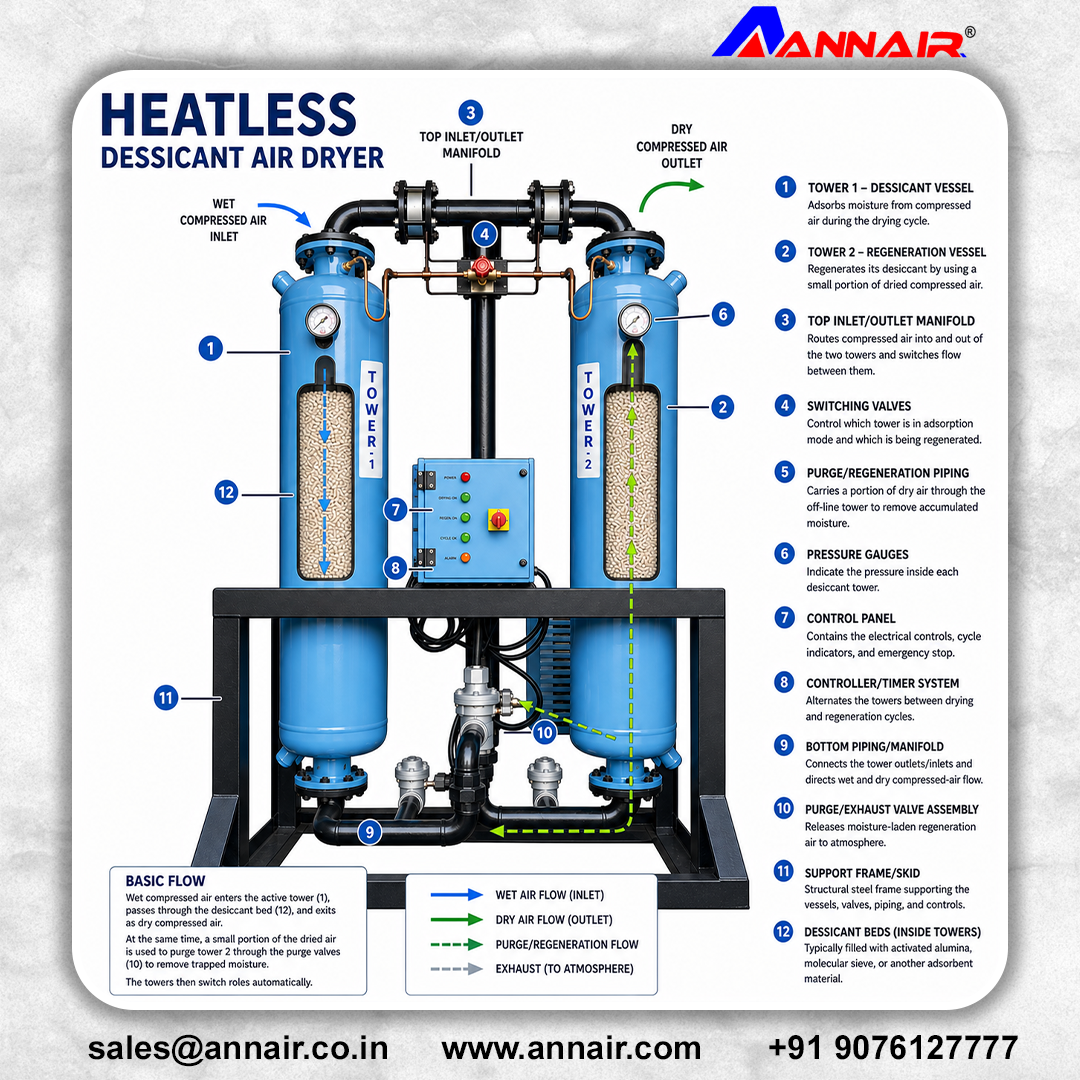
Heatless dryers use two towers operating in alternating cycles, so one is always drying the incoming air while the other is being regenerated.
The Twin-Tower Cycle
While Tower A is online and drying the compressed air, Tower B sits offline. A small portion of the already-dried air, usually somewhere around 15% of total output depending on the model, gets diverted through Tower B at low pressure. This purge air strips moisture out of the desiccant bed and carries it out through a muffler. After a set interval — commonly in the range of 4 to 10 minutes — the towers switch roles automatically through a set of pilot-operated valves, and the cycle repeats.
Why No External Heat Is Needed
The pressure drop across the purge orifice does the regeneration work on its own. There's no heater, no extra electrical load for warming air, which is exactly why heatless units are common in plants where space, wiring, or maintenance bandwidth is limited.
Key Components of a Desiccant Air Dryer
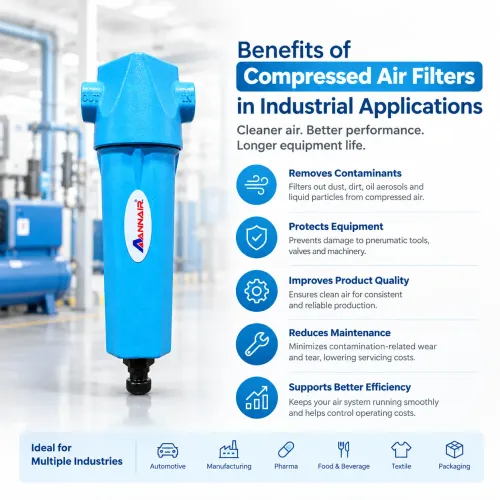
The core of any unit is the pair of pressure vessels, or towers, packed with desiccant beads such as activated alumina, silica gel, or molecular sieve, chosen based on the dew point target. Around that sit the inlet and outlet valves, generally solenoid- or pilot-air-operated, along with a purge orifice or flow-control valve that meters how much dry air is used for regeneration. A pre-filter ahead of the dryer removes bulk water, oil aerosols, and particulates before they reach the desiccant, while an after-filter downstream catches any fine desiccant dust that gets carried into the air line. A muffler handles the purge exhaust noise, and a timer or dew point-based controller manages the switching sequence between towers.
Applications in Mumbai's Industrial Belt
Desiccant dryers show up wherever compressed air quality directly affects the product or the process. CNC and VMC shops in Bhiwandi and Taloja use them ahead of pneumatic clamping and tool-change systems, where moisture in the air line causes corrosion inside cylinders over time. Electrical panel manufacturers around Ambernath and Dombivli rely on dry instrument air for pneumatic testing and for keeping panels free of condensation during assembly. Paint booths and powder coating lines need low dew point air to avoid moisture spotting on finished surfaces. Instrumentation air systems in process plants also specify desiccant drying as a baseline requirement, since instrument air standards typically call for dew points well below ambient conditions.
Heatless Desiccant vs Refrigerated Air Dryers
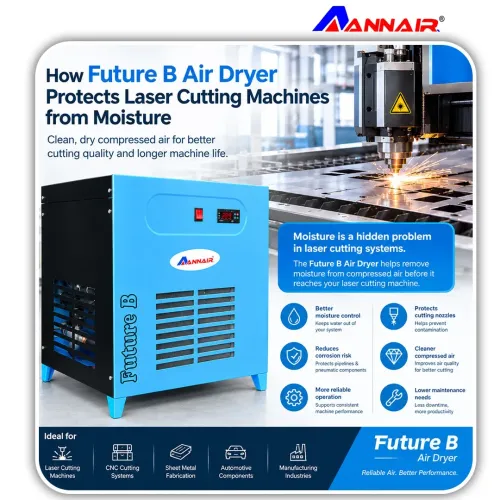
Refrigerated dryers are usually the more economical option and work well where a dew point around 3°C to 10°C is acceptable—general workshop air, most pneumatic tools, and standard automation. Once a process needs air that won't condense at low ambient temperatures, or the plant runs pneumatic instruments that are sensitive to moisture, a heatless desiccant dryer becomes the more suitable choice, even though it consumes some compressed air for purging and generally costs more upfront than a refrigerated unit of similar capacity.
Selection Factors Before Buying
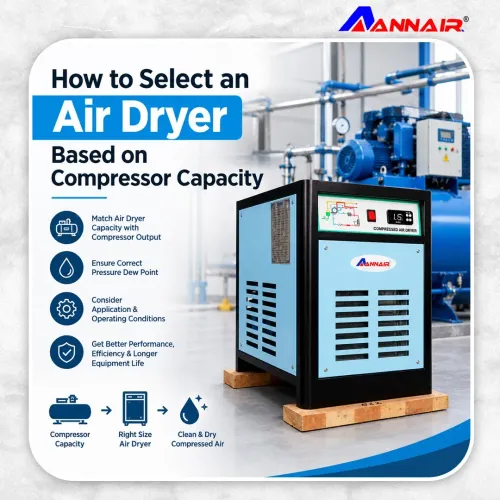
Sizing has to start with actual air demand, not just compressor capacity, since an undersized dryer will bypass wet air once flow exceeds its rated capacity. The dew point requirement of the connected equipment matters just as much—there's no benefit to paying for a -40°C dew point unit if the application only needs -20°C. Inlet air temperature and pressure both affect desiccant performance, so it helps to check these against the actual compressor discharge conditions rather than assumed values. Purge air loss is worth asking about directly, since older or poorly maintained units can consume more compressed air than newer designs with tighter valve control. Available floor space and ease of access for desiccant replacement are practical concerns too, especially in compact panel rooms or mezzanine compressor houses common across Mumbai's industrial sheds.
Common Problems and Their Solutions
Moisture breakthrough, where the outlet air suddenly shows a rising dew point, is usually traced to a stuck switching valve, a failed timer, or desiccant that's reached the end of its service life and needs replacement. Desiccant dust carryover into downstream equipment generally points to a missing or clogged after-filter or desiccant beads that have started breaking down from repeated thermal or pressure cycling. Unusually high purge air consumption often comes down to a worn purge orifice or a valve that isn't sealing fully during its offline half of the cycle. Routine inspection of the pre-filter drain, the valve seals, and desiccant condition prevents most of these issues before they affect production.
Maintenance Tips
Check and drain pre-filters regularly, since a saturated pre-filter pushes oil and water straight into the desiccant bed and shortens its life. Replace desiccant on the manufacturer's recommended schedule rather than waiting for a dew point failure, since performance degrades gradually before it becomes obvious. Keep a spare set of valve seals and a muffler element on hand, as these are the most common wear parts in a heatless dryer.
Conclusion
A desiccant air dryer earns its place in a compressed air system wherever moisture-sensitive equipment, low ambient temperatures, or process specifications rule out a refrigerated dryer. Understanding the twin-tower cycle, the role of each component, and where the unit fits against alternatives makes it easier to size and maintain correctly rather than treating it as a black box. Annair Drychill Tech (India) Pvt. Ltd. manufactures heatless desiccant air dryers for OEM and industrial customers across Mumbai, Maharashtra, and the UAE, and works directly with plant teams on sizing based on actual air demand and dew point requirements.
Frequently Asked Questions
What is a desiccant air dryer used for?
It's used to remove water vapor from compressed air down to a very low dew point, protecting pneumatic equipment, instrumentation, and finished products from moisture-related damage in applications where a refrigerated dryer's dew point isn't low enough.
What is a desiccant air dryer system, exactly?
It refers to the full arrangement of a pre-filter, dryer towers, after-filter, and controls working together, rather than just the dryer vessel on its own.
How is a heatless desiccant dryer different from a heated one?
A heatless dryer regenerates its desiccant using a portion of already-dried compressed air, while a heated dryer uses an external heater (electric or blower-heated) to drive off moisture, generally consuming less purge air but drawing more electrical power.
What dew point can a heatless desiccant dryer achieve?
Most standard units achieve a pressure dew point around -40°C, with some designs going lower depending on the desiccant type and cycle settings.
How often does the desiccant need to be replaced?
This depends on inlet air quality, operating hours, and desiccant type, so it's best confirmed against the manufacturer's recommendation rather than a fixed rule of thumb.
Can a desiccant dryer be added to a system that already has a refrigerated dryer?
Yes—some plants run a refrigerated dryer for general air and a desiccant dryer downstream for a specific line that needs a lower dew point, rather than replacing the whole system.
Do CNC or VMC machines really need desiccant-dried air?
It depends on the machine's pneumatic components and the plant's ambient humidity. Many CNC/VMC setups run fine on refrigerated-dried air, but units in high-humidity conditions or with sensitive pneumatic clamping systems often benefit from the lower, more stable dew point a desiccant dryer provides.
Need help sizing a desiccant air dryer for your plant?
Chat with Annair on WhatsApp →📞 Contact Us
📧 Sales@annair.co.in
🌐 annair.co.in
📞 +91 9076127777