
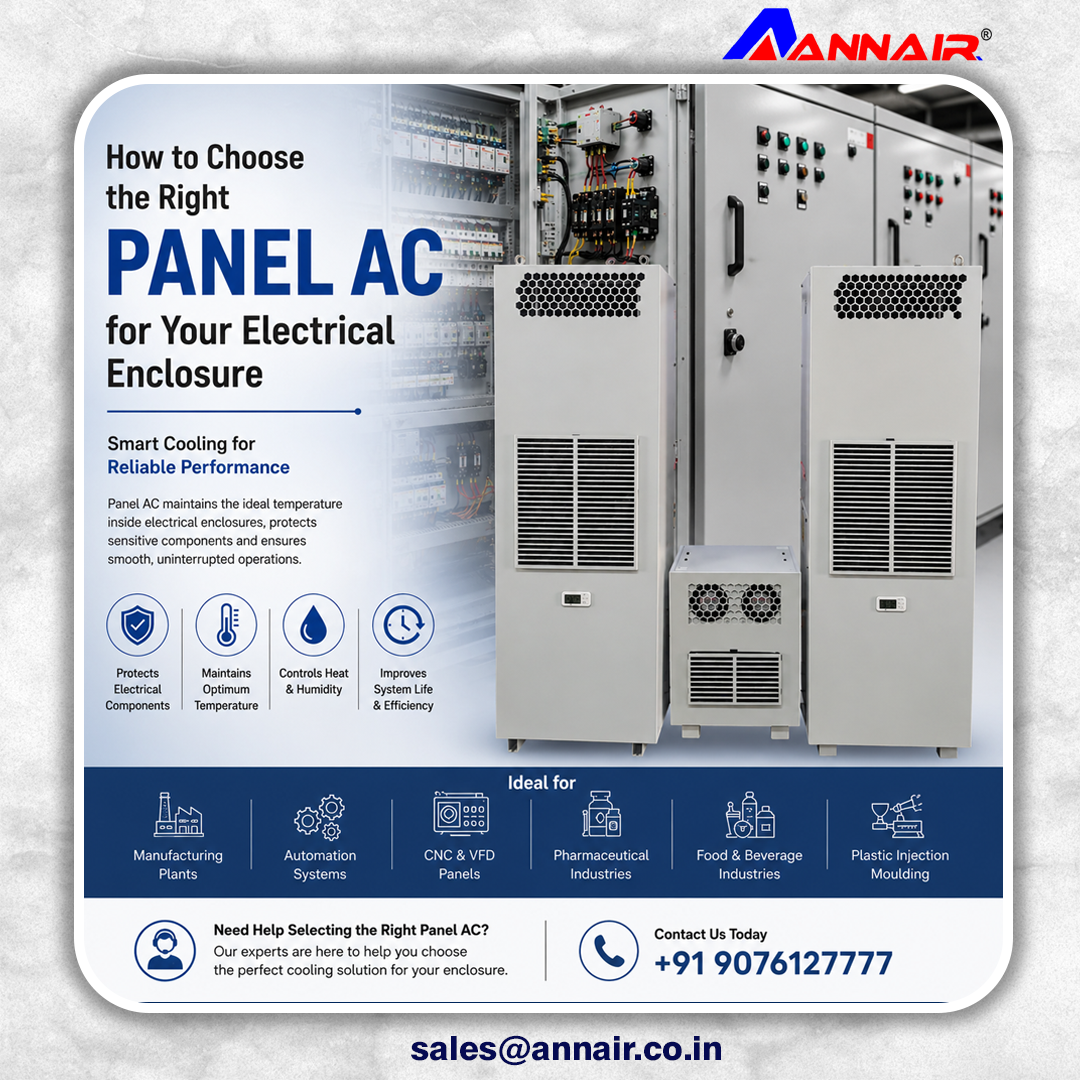
How to Choose the Right Panel AC for Your Electrical Enclosure
Electrical enclosures take a beating. Heat builds up from the drives, PLCs, power supplies, and other gear packed inside. Leave that heat unchecked, and you start seeing nuisance trips, shortened component life, and the occasional unexpected shutdown. A panel air conditioner (panel AC) is the usual fix, but picking the wrong one wastes money and still leaves the equipment vulnerable. Here’s a practical way to get it right without overcomplicating things.
Calculate the Heat Load Accurately
Start with the heat load. Everything inside the enclosure generates heat, and the ambient temperature around the enclosure adds more. Manufacturers usually list the power dissipation for each device in watts. Add those up, then factor in the heat that comes through the walls of the enclosure from the surrounding air. A rough rule of thumb is that every 10 °C difference between inside and outside can push a noticeable amount of extra heat into the box, especially if the enclosure is metal and sitting in a warm plant. Once you have a solid wattage number, convert it to BTU/hr (multiply watts by 3.41) so you can match it against the cooling capacity ratings on panel ACs. Always add a safety margin—15–25% is common—because components age, loads change, and ambient temperatures can spike.
Consider the Operating Environment
Next look at the environment. Indoor panels in a climate-controlled room are straightforward. Outdoor or harsh industrial settings are another story. Dust, oil mist, wash-down chemicals, and extreme temperatures all matter. Check the enclosure’s NEMA or IP rating and make sure the panel AC is rated for the same or better. Closed-loop units are preferred because they keep the clean internal air separate from the dirty outside air. If the enclosure sits in direct sun or near ovens, you’ll need a unit that can handle higher ambient temperatures—some industrial panel ACs are designed for 50 °C or even 55 °C ambient. In colder climates, look for models with low-ambient kits or heaters so the unit doesn’t freeze up or struggle to start.
Size, Mounting, and Physical Fit
Size and mounting style come next. Panel ACs mount on the side, top, or door of the enclosure. Side-mount is the most common because it keeps the center of gravity lower and leaves the top free for cable entry. Measure the available flat space carefully; the unit needs a solid mounting surface and enough clearance around the condenser intake and exhaust so air can move freely. Don’t forget the internal depth—some units stick into the enclosure more than others and can interfere with existing wiring or components. Weight also matters if the enclosure is wall-mounted or on a light frame.
Power and Electrical Requirements
Power supply and electrical compatibility are easy to overlook. Confirm the available voltage and phase (115 V, 230 V, 460 V, single or three-phase). Some units draw significant inrush current on start-up, so check that your control circuit and breakers can handle it. Energy efficiency has improved a lot in recent years; look for units with good EER ratings and variable-speed or smart controls if the enclosure runs continuously. Quieter operation is a bonus in control rooms or areas where people work nearby.
Controls, Monitoring, and Useful Features
Controls and monitoring features separate a basic unit from a more useful one. At minimum you want an adjustable thermostat and a high-temperature alarm contact that can signal a PLC or SCADA system. Better units include digital displays, remote monitoring capability, and condensate management systems that either evaporate the water or pump it away cleanly. Condensate is a real issue—left unmanaged, it can drip onto components or create a mess on the floor.
Maintenance Access and Long-Term Reliability
Maintenance access and filter design matter more than most people expect. Filters need to be easy to clean or replace without taking the whole unit apart. In dusty plants, plan on checking them regularly. Some designs use washable filters; others use disposable ones. Also check the warranty and spare-parts availability. A unit that is hard to service or whose compressor is no longer stocked becomes expensive fast.
Match the Unit to Real-World Duty
Finally, match the unit to the actual duty cycle. Continuous operation in a hot environment puts more stress on the compressor than intermittent use. Look at the manufacturer’s published data for maximum ambient temperature at the rated cooling capacity. If the numbers look optimistic, derate a little further. Talk to the supplier with your real heat-load calculation and site conditions rather than just ordering the cheapest unit that roughly matches the BTU number.
Choosing a panel AC is mostly careful measurement and honest assessment of the environment. Get the heat load right, respect the ambient conditions, leave room for mounting and airflow, and pick a unit with the electrical and monitoring features you actually need. Do that and the enclosure stays cool, the electronics last longer, and you avoid the costly surprises that come from undersized or poorly matched cooling.
📞 Contact Us
Do you have questions about our air dryers, chillers, or compressed air solutions?
Our team is here to assist you with product details, quotations, or technical support.
📞 Phone: +91-9076127777
📧 Email: sales@annair.co.in
🌐 Website: www.annair.co.in