
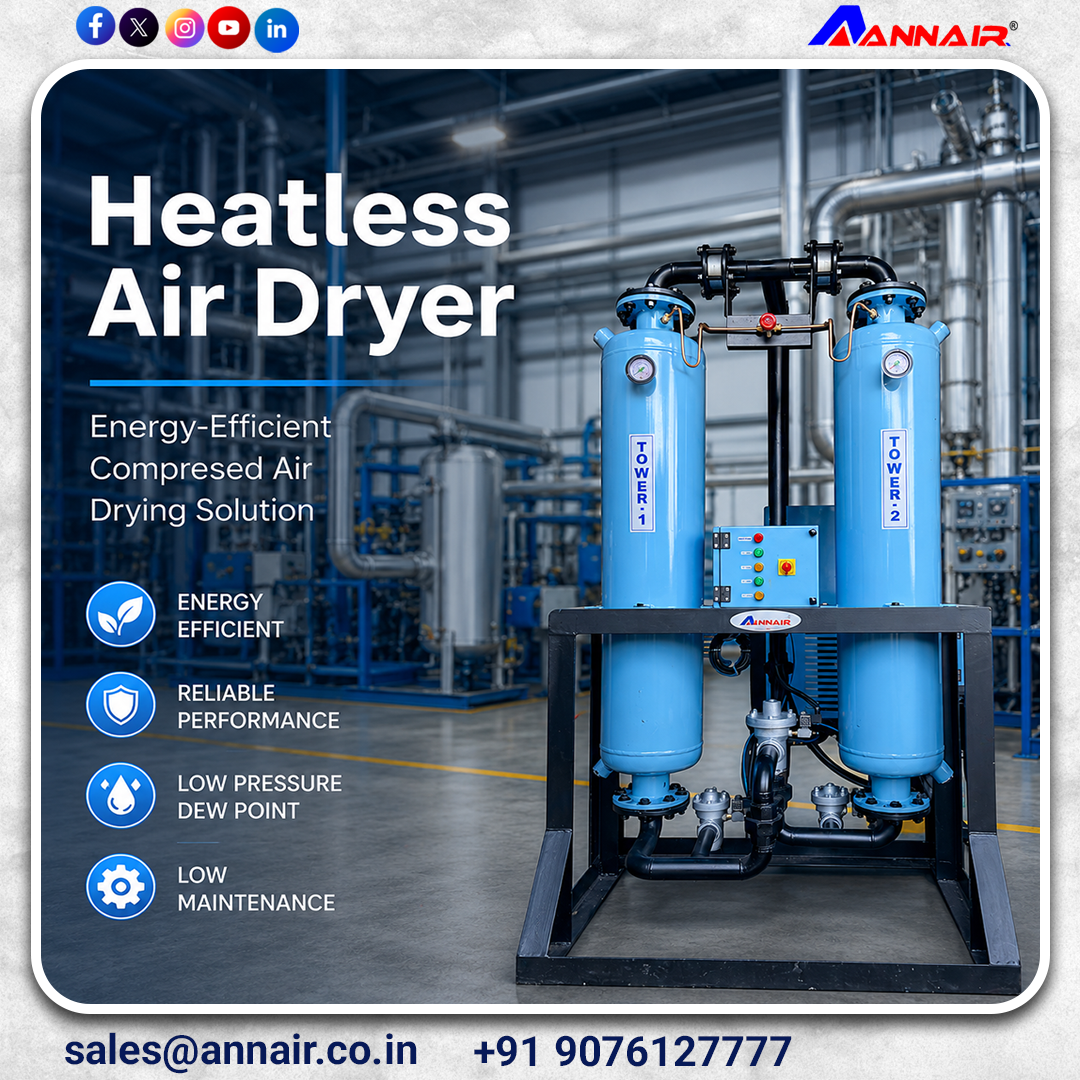
Heatless Air Dryer: Energy-Efficient Compressed Air Drying Solution
Compressed air is one of the most important utilities in modern industries, but untreated compressed air contains moisture that can damage pneumatic equipment, corrode pipelines, and reduce production efficiency. A heatless air dryer is a reliable solution designed to remove water vapor from compressed air without using external heaters. These dryers utilize the adsorption principle to achieve extremely low pressure dew points, making them suitable for industries that require consistently dry compressed air.
Whether you operate a manufacturing plant, pharmaceutical facility, food processing unit, or electronics factory, installing a heatless air dryer helps protect valuable equipment while improving overall system reliability.
What Is a Heatless Air Dryer?
A heatless air dryer is a type of desiccant air dryer that removes moisture by passing compressed air through a desiccant material such as activated alumina or molecular sieve. Unlike heated dryers, it does not require electrical heaters for regeneration. Instead, it uses a small portion of the already dried compressed air to regenerate the saturated desiccant.
Most heatless air dryers consist of two pressure vessels operating alternately. While one tower dries the compressed air, the other undergoes regeneration. This continuous switching ensures a steady supply of dry compressed air without interrupting production.
Heatless air dryers are capable of achieving pressure dew points as low as -40°C, with optional designs reaching -70°C, making them ideal for critical industrial applications.
How Does a Heatless Air Dryer Work?
Adsorption Drying Process
The compressed air enters the online drying tower and flows through the desiccant bed. As the air passes through, moisture is adsorbed onto the surface of the desiccant beads, allowing only clean and dry air to exit the system.
Regeneration Cycle
Once the desiccant becomes saturated, the control system switches airflow to the second tower. A small percentage of dry compressed air, typically around 12–15%, is expanded to atmospheric pressure and directed through the saturated desiccant. This purge air removes accumulated moisture and restores the drying capacity of the desiccant, preparing it for the next drying cycle.
The entire process operates automatically through timers or dew-point controllers, ensuring uninterrupted operation.
Key Benefits of Heatless Air Dryers
A heatless air dryer offers several advantages for industrial compressed air systems:
- Reliable moisture removal with pressure dew points up to -40°C or lower.
- Simple construction with fewer moving parts for easy maintenance.
- No external heating required, reducing installation complexity.
- Continuous operation using twin-tower technology.
- Protection Against Corrosion in pipelines and pneumatic systems.
- Improved product quality by eliminating moisture contamination.
- Long service life with proper desiccant maintenance.
- Suitable for harsh industrial environments where dependable performance is essential.
These benefits make heatless dryers one of the most popular choices for industries requiring high-quality compressed air.
Common Industrial Applications
Heatless air dryers are widely used across multiple industries where moisture-free compressed air is essential.
| Industry | Application |
|---|---|
| Pharmaceutical | Tablet manufacturing, packaging |
| Food & Beverage | Packaging, bottling, processing |
| Automotive | Paint booths, pneumatic tools |
| Electronics | PCB manufacturing and assembly |
| Textile | Air-operated machinery |
| Chemical | Process instrumentation |
| Medical | Instrument air systems |
| Manufacturing | CNC machines and automation |
Each of these industries depends on dry compressed air to maintain production quality, reduce downtime, and extend equipment life.
Factors to Consider Before Buying
Choosing the right heatless air dryer requires evaluating several important factors:
- Required airflow capacity (CFM or Nm³/hr)
- Operating pressure
- Desired pressure dew point
- Ambient operating conditions
- Purge air consumption
- Energy efficiency
- Desiccant quality
- Automatic control features
- Maintenance requirements
- Availability of after-sales service and spare parts
Selecting the correct model ensures optimal performance while minimizing operating costs throughout the equipment's lifespan.
Conclusion
A heatless air dryer is an efficient and dependable solution for removing moisture from compressed air in industrial applications. By using advanced adsorption technology and automatic twin-tower operation, these dryers provide consistently dry air without the need for external heating. Their simple design, low maintenance requirements, and ability to achieve very low dew points make them an excellent investment for industries where compressed air quality directly affects productivity and equipment reliability.
Businesses seeking long-term protection for pneumatic systems, manufacturing equipment, and sensitive production processes can benefit significantly from installing a properly sized heatless air dryer.