
How Does A Water Chiller Work? water chiller
Meta Title: How Does A Water Chiller Work? | Complete Guide For OEMs & Manufacturers Meta Description: Wondering how a water chiller works or how a water-cooled chiller works? Here's the real, no-fluff explanation—plus how to pick the right one for your plant. URL Slug: /how-does-a-water-chiller-work
I get this question a lot. Usually from a plant manager who's just been handed a process cooling problem and told to "figure it out by Friday."
So let's figure it out.
If you've typed "how does a water chiller work" into Google, you're probably not looking for a physics lecture. You want to understand the machine well enough to buy the right one, size it correctly, or explain it to your boss without sounding unsure. That's exactly what this post covers.
We'll go through the working principle, the two main types, where things usually go wrong on the shop floor, and how to actually choose one for your application. No jargon dump. Just the stuff that matters.
What A Water Chiller Actually Does
Strip away the technical language, and a chiller does one job: it removes heat from water (or a water-glycol mix) and dumps that heat somewhere else.
That's it.
The chilled water then circulates through your process — a plastic injection molding machine, a laser cutter, an induction furnace, a laboratory reactor, whatever it is — and pulls heat away from it. The water comes back warm. The chiller cools it again. Round and round it goes.
Simple concept. The engineering underneath is where it gets interesting.
The Core Working Principle: Vapor Compression Refrigeration
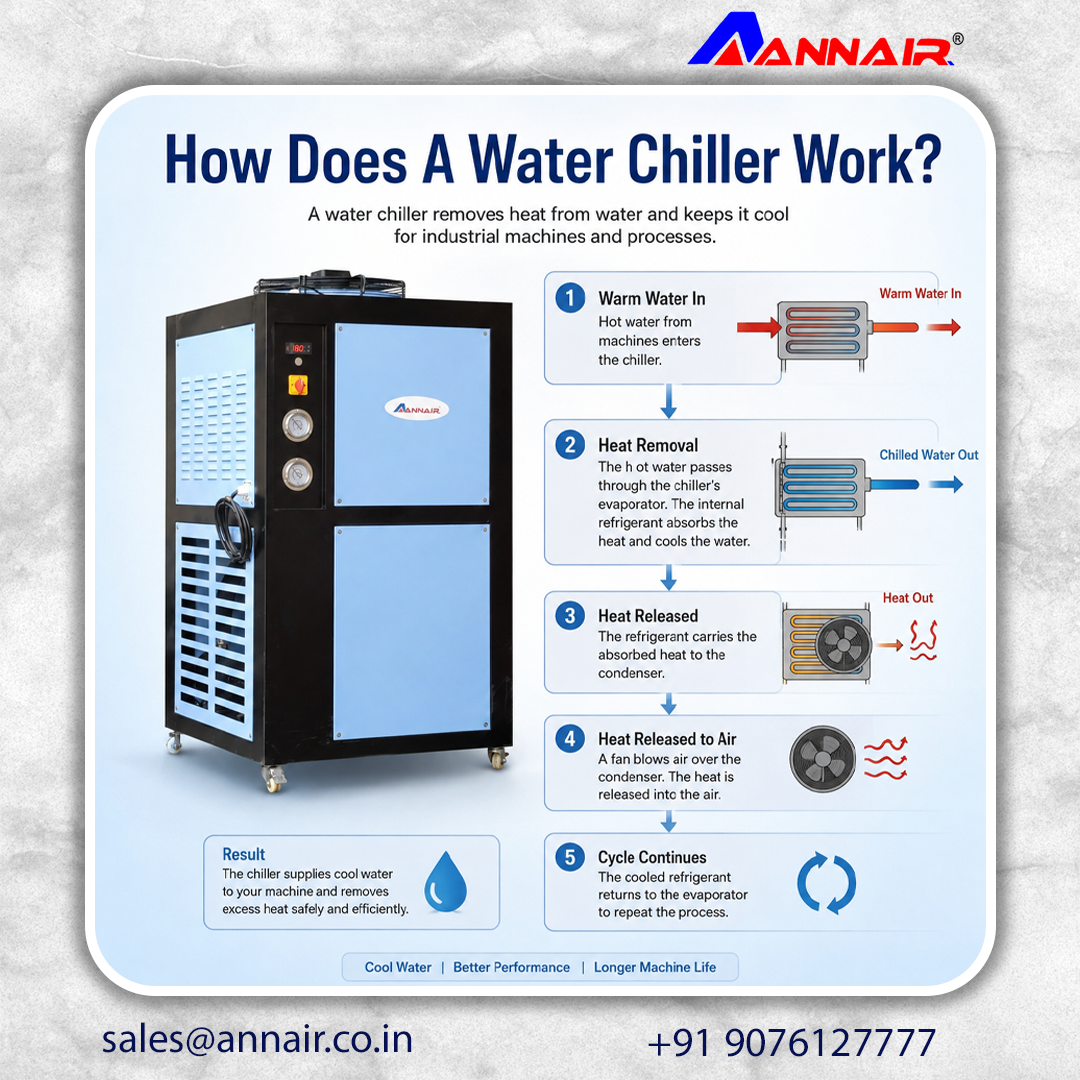
Almost every industrial water chiller runs on the same basic refrigeration cycle you'd find in your home AC or your fridge. Just scaled up and built tougher.
Here's the loop, step by step:
1. Evaporator — heat gets picked up Warm water from your process flows through the evaporator. Inside, a refrigerant is running at low pressure and low temperature. The refrigerant absorbs heat from the water and turns into a gas. The water leaves the cooler. The refrigerant leaves warmer.
2. Compressor — pressure goes up That refrigerant gas gets pulled into the compressor. This is the heart of the machine, honestly. The compressor squeezes the gas, raising both its pressure and temperature significantly.
3. Condenser — heat gets released The hot, high-pressure gas now moves to the condenser. Here, that heat gets rejected — either to air (via a fan) or to a separate water loop (via a cooling tower or another water source). The refrigerant condenses back into a liquid.
4. Expansion valve — pressure drops again The liquid refrigerant passes through an expansion device (a thermostatic expansion valve, usually). Pressure drops. Temperature drops. It's ready to absorb heat again.
Then it repeats. Continuously. For years, if the unit's built right.
Ask us for a working principle diagram if you want to see this mapped out visually for a technical presentation or OEM datasheet — we've built these for clients before.
Air-Cooled Vs. Water-Cooled Chillers: Which One Are You Actually Asking About?
This is where "how does a water chiller work" branches into two different answers, because there are two very different machines wearing the same name.
Air-Cooled Chillers
These reject heat straight to the atmosphere using condenser fans. No cooling tower needed. No secondary water loop.
Good fit when:
- You've got limited access to a water source
- You want lower installation complexity
- Your facility is in a location with manageable ambient temperatures
How Does a Water-Cooled Chiller Work? (This One's Different)
A water-cooled chiller uses a separate water circuit—usually tied to a cooling tower—to carry away condenser heat instead of blowing it into the air.
The refrigeration cycle inside is the same. What changes is the condenser. Instead of air passing over condenser coils, condenser water (often from a cooling tower) flows through a shell-and-tube or plate heat exchanger, picking up the rejected heat and carrying it outside.
Why manufacturers often prefer water-cooled units:
- Better efficiency, especially in high-ambient or dusty industrial environments
- Lower discharge pressures, which usually means longer compressor life
- Quieter operation — no large condenser fans running constantly
- Works well for continuous, heavy-duty process loads
Trade-off? You need water treatment for the cooling tower loop and a bit more space and plumbing. For most large-scale manufacturing setups, that trade-off is worth it.
We build both types. If you're not sure which fits your process, send us your load details, and we'll tell you straight—not just push whichever one's easier to sell.
Where Chillers Actually Get Used (And Why It Matters For Sizing)
Different industries lean on chillers differently, and the "right" chiller for a plastics OEM looks nothing like the right chiller for a pharma manufacturer.
- Plastic & rubber processing — mold temperature control, cycle time consistency
- Injection molding OEMs — supplying chillers as part of a packaged machine
- Machine tool & laser cutting — spindle and optics cooling
- Food & beverage — process cooling, fermentation control
- Pharma & chemical — reactor jacket cooling, tight temperature tolerance
- Data centers & server rooms — precision cooling for IT load
- Electroplating & metal finishing — bath temperature control
Notice something? Every one of these has a different heat load, a different required temperature range, and a different tolerance for temperature fluctuation. That's why sizing a chiller off a generic online calculator usually backfires. We'll get to that.
The Problems I See Most Often On Site
After years of doing this, the same handful of issues show up again and again. If any of these sound familiar, you're not alone—and there's usually a fairly straightforward fix.
Undersized chillers. Someone specs a unit based on nameplate rating instead of actual peak heat load. Six months later, the process is running warm, and nobody knows why.
Wrong type for the environment. Air-cooled units installed in high-dust, high-ambient shop floors that would've been far better served by water-cooled systems.
No redundancy for critical processes. One chiller, one point of failure, and a production line that stops the moment it trips.
Skipping the water treatment conversation. Water-cooled systems need decent water quality. Skip this, and you're looking at scaling and fouled heat exchangers within a year or two.
Buying purely on price. I understand budget pressure, genuinely. But a cheap compressor that fails in 18 months costs more than a reliable one that runs for a decade.
None of this is meant to scare you. It's meant to save you a call to us six months from now that starts with "the chiller's not keeping up."
How To Actually Size And Select A Water Chiller
If you want a chiller that doesn't become a headache, here's roughly what we walk through with OEMs and manufacturers before we recommend anything:
- Calculate actual heat load—not estimated, calculated. Based on your process, not a rule of thumb.
- Confirm required water temperature and tolerance—some processes need ±0.5°C control, others are fine with ±3°C.
- Decide air-cooled vs. water-cooled—based on ambient conditions, space, and water availability.
- Check flow rate requirements — undersized pumps starve the process even with a correctly sized chiller.
- Plan for future capacity—if you're scaling production in the next 2–3 years, size for that now.
- Factor in maintenance access — a chiller that's hard to service will get neglected. Simple as that.
Honestly, this is a 15-minute conversation with someone who knows what they're doing. It saves months of trial and error.
Not sure what size or type your process needs? Send us your heat load details, and we'll work it out with you—no obligation, just a straight answer.
Why Manufacturers And OEMs Work With Annair
We're not a trading company reselling someone else's chiller with our sticker on it. Annair Drychill Tech designs and manufactures air-cooled and water-cooled chillers, refrigerated air dryers, panel air conditioners, and compressed air treatment equipment out of our facility in Ambernath, Maharashtra—supplying OEMs, system integrators, and manufacturers across India and the UAE.
A few reasons plants keep coming back to us:
- Built for Indian industrial conditions—high ambient temperatures, dusty environments, and voltage fluctuations. We design for the real shop floor, not a lab spec sheet.
- OEM-friendly — if you're a compressor OEM or panel builder, we work with your specs and timelines, not against them.
- Serviceable by design — accessible components, common spares, less downtime when something does need attention.
- Direct technical support — you talk to someone who actually understands refrigeration, not a call center script.
We've supplied units into plastics processing, machine tool manufacturing, pharma, and general industrial applications across Maharashtra, greater India, and the UAE—Dubai, Sharjah, and Jebel Ali included.
Quick FAQ
How does a water chiller work in simple terms? It pulls heat out of water using a refrigeration cycle, then dumps that heat elsewhere — either into the air or into a separate water loop — so the cooled water can go back and absorb more heat from your process.
How does a water-cooled chiller work differently from an air-cooled one? Both use the same refrigeration cycle. The difference is how they get rid of heat at the condenser—air-cooled units use fans and ambient air; water-cooled units use a water loop, typically tied to a cooling tower.
What's more efficient—air-cooled or water-cooled? Water-cooled chillers are generally more efficient, especially in hot, dusty industrial environments, because they reject heat more effectively than air can in those conditions.
How do I know what size chiller I need? You need your actual heat load in kW or TR (tons of refrigeration), your required water temperature, and your flow rate. We can help you calculate this if you're not sure — just send us your process details.
Do you supply chillers for OEM integration? Yes. We regularly supply both air-cooled and water-cooled chillers to OEMs and panel builders as part of their packaged machines, built to their specifications.
Ready To Get This Sorted?
If you're speccing a chiller for a new line, replacing an underperforming unit, or just trying to understand your options before you talk to a vendor—we're happy to help, no pressure attached.
Contact Annair Drychill Tech at Sales@annair.co.in and tell us about your application. We'll give you a straight recommendation based on your actual load and environment, not a generic catalog pick.
Choose Annair, Your Trusted Partner for Industrial Water Chillers.
Contact Annair today for a free consultation and get the perfect chiller solution customized for your factory's needs.
📱 WhatsApp: +91 9076127777
📧 Email: sales@annair.co.in
🌐 Website: www.annair.com